6 Kalimas in Islam
with Arabic, English Translation, and Transliteration

The 6 Kalimas of Islam are among the first things many Muslims learn. They contain essential beliefs, declarations of faith, repentance, and remembrance of Allah. These Kalimas help Muslims strengthen their faith, understand the core teachings of Islam, and develop a closer relationship with Allah.

Although the six Kalimas are not compiled together in a single Hadith or verse of the Quran, they contain important Islamic teachings derived from the Quran and authentic Sunnah. Muslims around the world teach these Kalimas to children and new learners as part of their basic Islamic education.

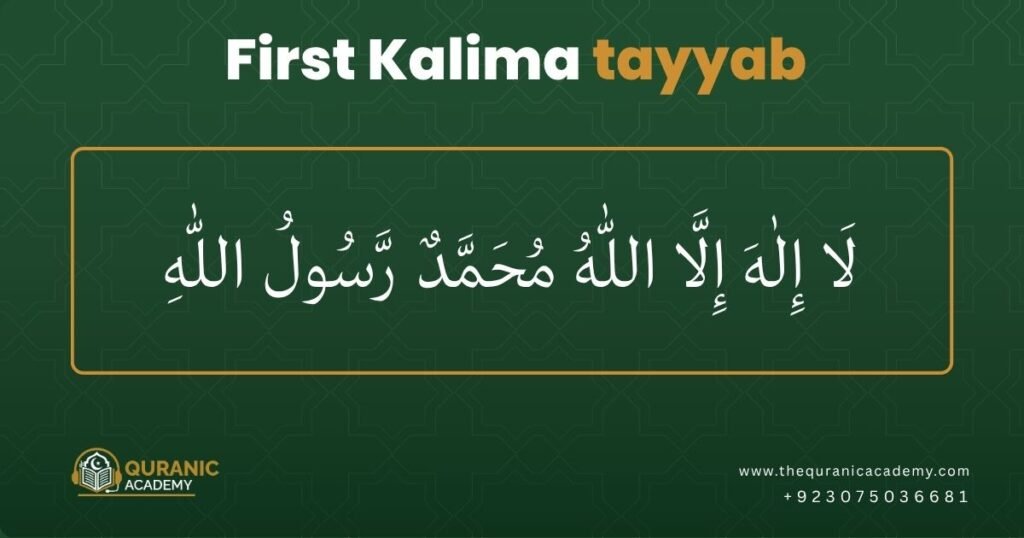
First Kalima: Tayyab

Transliteration of First Kalma

La ilaha illallahu Muhammadur Rasoolullah

English Translation of First Kalma

There is no god worthy of worship except Allah, and Muhammad ﷺ is the Messenger of Allah.

First Kalima Tayyab

Meaning and Importance

The First Kalima is the foundation of Islam. It declares belief in the Oneness of Allah (Tawheed) and acceptance of Prophet Muhammad ﷺ as Allah’s final Messenger. Every Muslim enters Islam by sincerely believing and declaring this testimony of faith.

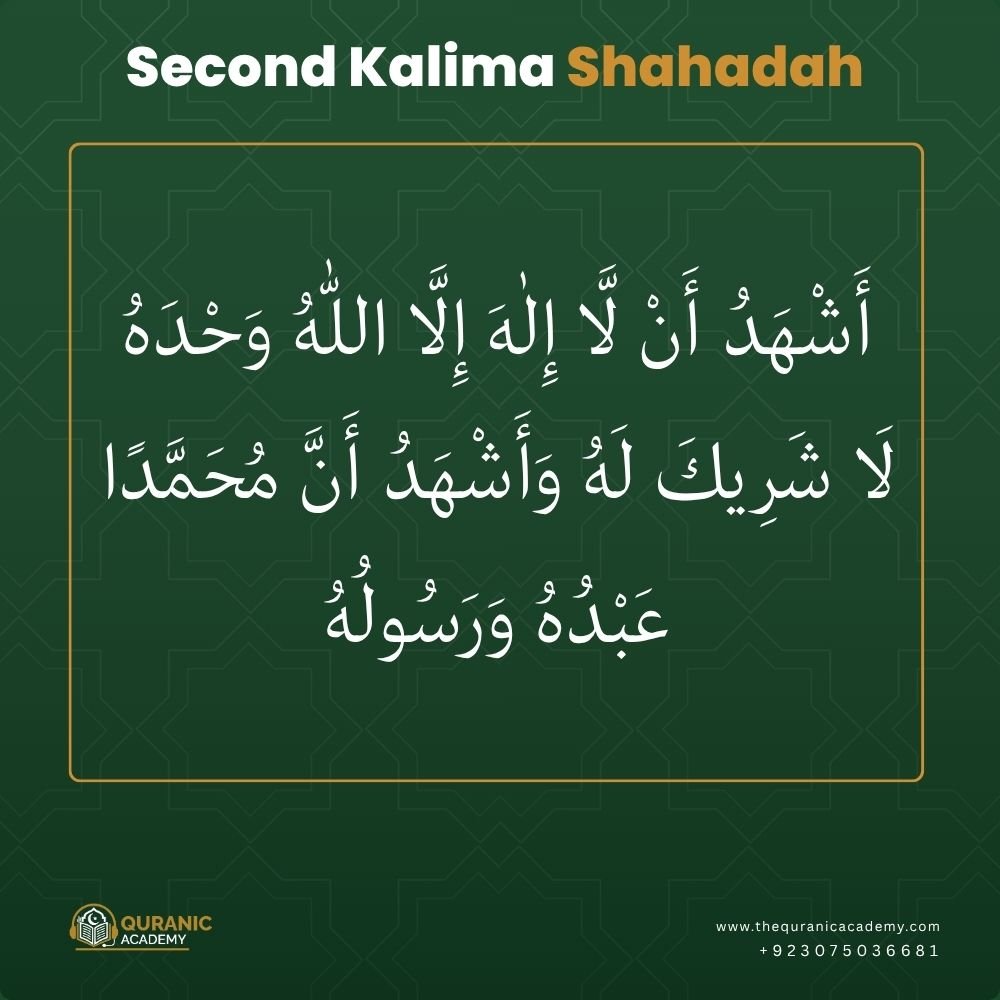
Second Kalima: Shahadah

Transliteration of Second Kalma

Ashhadu an la ilaha illallahu wahdahu la sharika lahu wa ashhadu anna Muhammadan abduhu wa rasooluhu

English Translation of Second Kalma

I bear witness that there is no god worthy of worship except Allah alone, who has no partner, and I bear witness that Muhammad ﷺ is His servant and Messenger.

Meaning and Importance

The Second Kalima strengthens a Muslim’s testimony of faith and reinforces the core beliefs of Islam. It emphasizes the Oneness of Allah (Tawheed), affirming that He alone deserves worship and has no partners. It also confirms that Prophet Muhammad ﷺ is Allah’s servant and final Messenger. By reciting and understanding this Kalima, Muslims renew their faith, deepen their connection with Allah, and reaffirm their commitment to following the teachings of Islam.

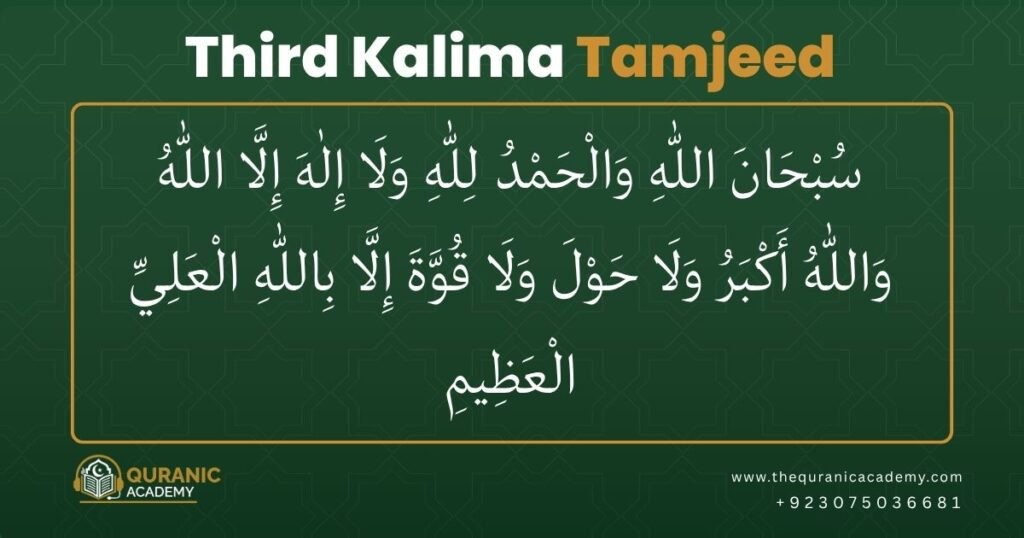
Third Kalima: Tamjeed

Transliteration of Third Kalma

Subhanallahi walhamdu lillahi wa la ilaha illallahu wallahu akbar. Wa la hawla wa la quwwata illa billahil Aliyyil Azeem

English Translation of Third Kalma

Glory be to Allah, all praise belongs to Allah, there is no god except Allah, Allah is the Greatest, and there is no power or strength except with Allah, the Most High, the Most Great.

Third Kalima Tamjeed

Meaning and Importance

The Third Kalima is a beautiful collection of words of remembrance (Dhikr) that glorify and praise Allah. It reminds believers of Allah’s greatness, absolute power, and majesty. By reciting this Kalima, Muslims declare that all praise belongs to Allah alone, acknowledge His supreme authority, and recognize that no one has the power or strength except through Him. Regular recitation of this Kalima helps strengthen faith (Iman), increases mindfulness of Allah, and brings peace and comfort to the heart. It also encourages Muslims to remember Allah frequently in their daily lives, as remembrance of Allah is a source of spiritual reward and inner tranquility.

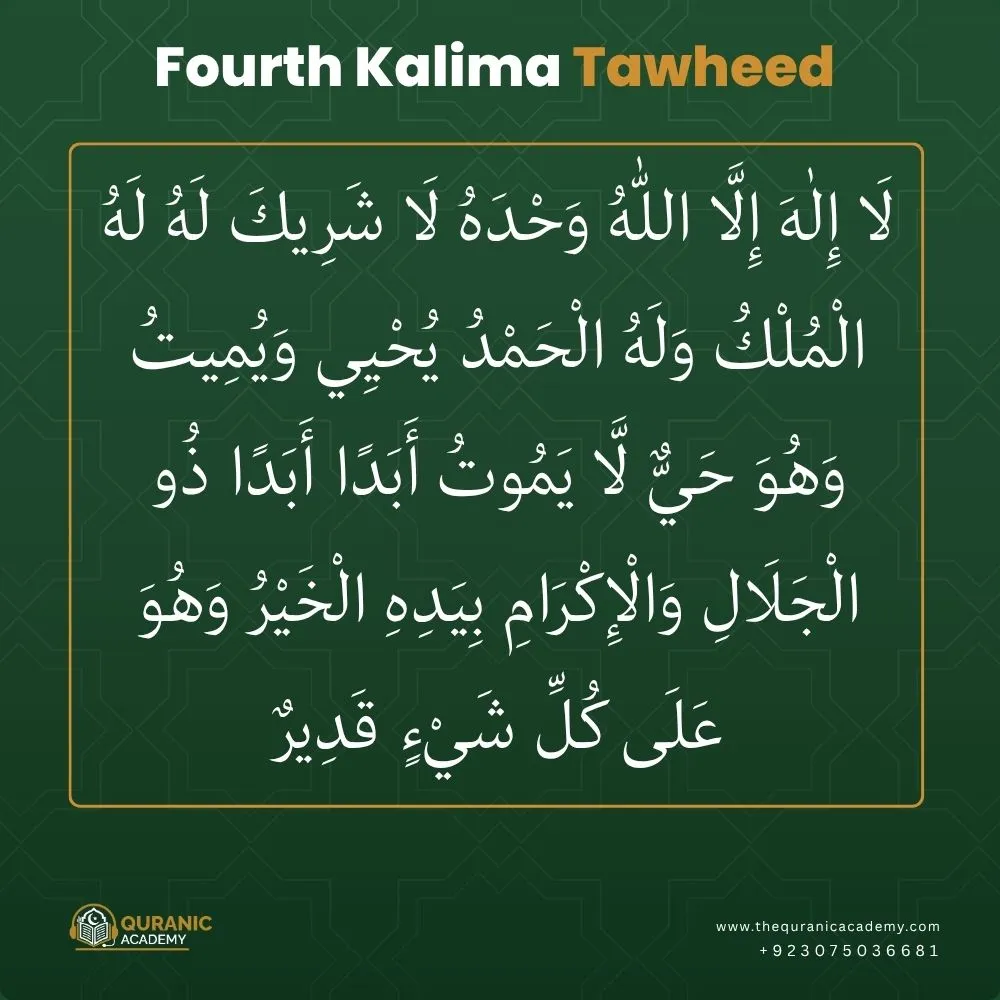
Fourth Kalima: Tawheed

Fourth Kalima Tawheed

Transliteration of Fourth Kalma

La ilaha illallahu wahdahu la sharika lahu, lahul mulku wa lahul hamdu, yuhyi wa yumeetu wa huwa hayyun la yamootu abadan abada, zul jalali wal ikram, biyadihil khair, wa huwa ala kulli shay’in qadeer

English Translation of Fourth Kalma

There is no god worthy of worship except Allah alone. He has no partner. To Him belongs the kingdom and all praise. He gives life and causes death, and He is Ever-Living and never dies. He is the Possessor of Majesty and Honor. In His Hand is all goodness, and He has power over all things.

Meaning and Importance

The Fourth Kalima beautifully emphasizes the concept of Tawheed—the absolute Oneness of Allah. It declares that Allah alone deserves worship, has no partners, and possesses complete authority over the heavens and the earth. This Kalima highlights Allah’s eternal existence, reminding believers that He is Ever-Living and never dies. It also affirms that all praise, power, goodness, and sovereignty belong to Him alone. By reciting and reflecting upon this Kalima, Muslims strengthen their faith, increase their trust in Allah, and deepen their understanding of His greatness, mercy, and supreme control over all things.

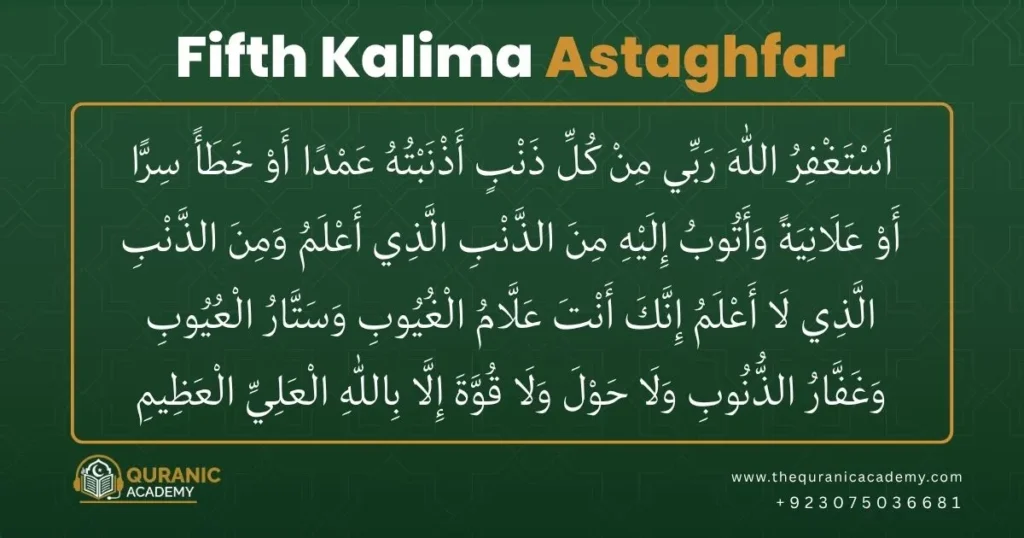
Fifth Kalima: Astaghfar

Transliteration of Fifth Kalma

Astaghfirullaha rabbi min kulli zambin aznabtuhu amadan aw khata’an sirran aw alaniyatan wa atoobu ilaihi minaz zambil lazi a’lamu wa minaz zambil lazi la a’lamu innaka anta allamul ghuyoobi wa sattarul uyubi wa ghaffaruz zunubi wa la hawla wa la quwwata illa billahil Aliyyil Azeem

English Translation of Fifth Kalma

I seek forgiveness from Allah, my Lord, for every sin I committed knowingly or unknowingly, secretly or openly, and I turn to Him in repentance. Indeed, You are the Knower of the unseen, the Concealer of faults, and the Forgiver of sins. There is no power or strength except with Allah, the Most High, the Most Great.

Fifth Kalima Astaghfar

Meaning and Importance

The Fifth Kalima teaches Muslims the importance of seeking forgiveness (Istighfar) and turning to Allah in sincere repentance (Tawbah). It reminds believers to ask Allah for forgiveness for all sins, whether committed knowingly or unknowingly, openly or in secret. This Kalima encourages Muslims to reflect on their actions, acknowledge their mistakes, and seek Allah’s mercy with humility and sincerity. Regular recitation of the Fifth Kalima helps purify the heart, strengthens one’s relationship with Allah, and reminds believers that Allah is the Most Forgiving and Most Merciful. It also inspires Muslims to avoid sins, improve their character, and strive to live a life that is pleasing to Allah.

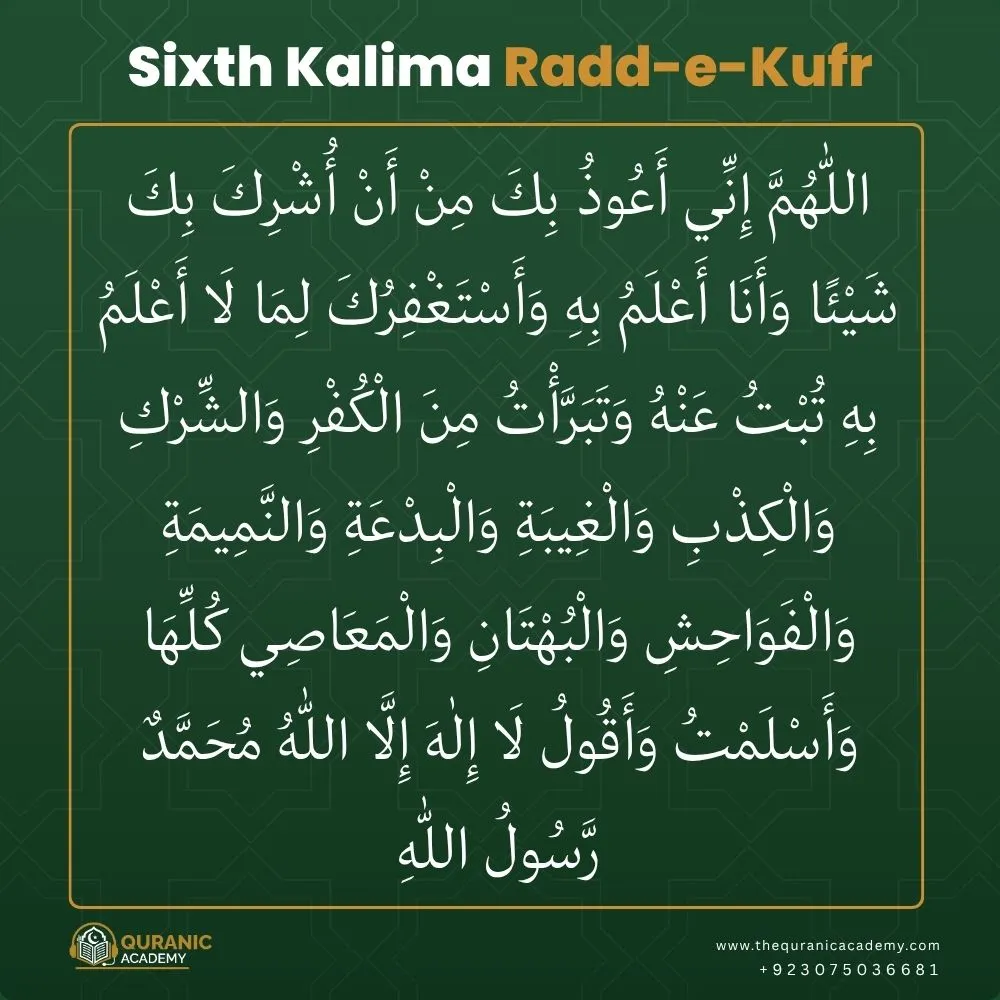
Sixth Kalima: Radd-e-Kufr

Transliteration of Sixth Kalma

Allahumma inni a’oodhu bika min an ushrika bika shai’an wa ana a’lamu bihi wa astaghfiruka lima la a’lamu bihi tubtu anhu wa tabarra’tu minal kufri wash shirki wal kizbi wal gheebati wal bid’ati wan nameemati wal fawahishi wal buhtani wal ma’asi kulliha wa aslamtu wa aqoolu la ilaha illallahu Muhammadur Rasoolullah

English Translation of Sixth Kalma

O Allah, I seek refuge in You from knowingly associating partners with You, and I seek Your forgiveness for what I do unknowingly. I repent from it and reject disbelief, shirk, falsehood, backbiting, innovation, slander, indecency, and all sins. I submit to You and declare that there is no god worthy of worship except Allah, and Muhammad ﷺ is the Messenger of Allah.


Meaning and Importance

The Sixth Kalima teaches Muslims to seek Allah’s protection from disbelief (Kufr), shirk (associating partners with Allah), and all forms of sin. It is a powerful declaration of repentance and a renewal of one’s faith in Islam. Through this Kalima, believers ask Allah for forgiveness for both known and unknown sins while reaffirming their commitment to worship Him alone. It also encourages Muslims to avoid harmful actions such as lying, backbiting, slander, and other sinful behaviors. Reciting and reflecting upon the Sixth Kalima helps strengthen faith (Iman), purify the heart, and remind believers to remain steadfast on the path of Islam throughout their lives.

Frequently Asked Questions

Everything You Need to Know Before Starting Your Quran Learning Journey

What are the 6 Kalimas in Islam?

The 6 Kalimas are declarations of faith, remembrance, repentance, and belief that are commonly taught to Muslims. They help Muslims strengthen their faith (Iman), remember Allah, and understand the basic teachings of Islam.

The Six Kalimas are not compiled together in a single verse of the Quran or one specific Hadith. However, they contain authentic Islamic beliefs, supplications, and words of remembrance that are derived from the Quran and Sunnah.

The 6 Kalimas are important because they teach Muslims about Tawheed (the Oneness of Allah), the prophethood of Muhammad ﷺ, repentance, seeking forgiveness, and remembrance of Allah. They also help strengthen a Muslim’s faith and understanding of Islam.

Although memorizing the Six Kalimas is not obligatory, many Muslims learn them from childhood because they contain important Islamic teachings and help strengthen faith and daily worship.

Yes, the Six Kalimas are highly beneficial for new Muslims. They provide a simple and easy way to learn the core beliefs of Islam, understand Tawheed, and increase remembrance of Allah.

“La ilaha illallahu Muhammadur Rasoolullah”

It means: “There is no god worthy of worship except Allah, and Muhammad ﷺ is the Messenger of Allah.”

The First Kalima is a brief declaration of faith, while the Second Kalima (Shahadah) provides a more detailed testimony affirming the Oneness of Allah and the prophethood of Muhammad ﷺ.

Children can memorize the Six Kalimas by learning one Kalima at a time, listening to regular recitations, understanding the meanings, and practicing them daily with their parents or teachers.

Didn’t Find Your Question? Ask Us Directly!

We’re here to make your Quran learning journey clear and comfortable. If you have any question — big or small — send it to us, and we’ll respond promptly with the answer you need.

Other Quran & Islamic Courses You May Like

Choose the course that’s right for you and start your Quran  learning journey today