




Introduction
In Islam, prayer (Salah) is the most important act of worship after believing in Allah. But before a Muslim stands before their Creator, they must be in a state of physical and spiritual purity.
That is where wudu comes in.
Wudu is the process of washing certain parts of the body before praying. It prepares not just the body, but also the mind and heart for standing in front of Allah with humility and respect.
For new Muslims, learning wudu is one of the very first steps in building a daily connection with Allah.
What Is Wudu?
Wudu (وضو) is an Islamic ritual purification. It involves washing specific parts of the body in a set order using clean water.

Purpose of Wudu
- To purify yourself before prayer.
- To be in a state of spiritual cleanliness.
- To follow the command of Allah.
Wudu in the Quran
Allah says in the Quran (5:6):
“O you who believe! When you rise to pray, wash your faces and your arms up to the elbows, wipe your heads, and wash your feet up to the ankles.”
This verse forms the foundation of wudu.
When Is Wudu Required?
As a beginner, it’s important to know when exactly you need to have wudu.
You must perform wudu before:
1. Praying the five daily prayers (Salah).
Even for short prayers like 2 raka’at.
2. Touching the physical copy of the Quran.
(Reading on a phone app does NOT require wudu.)
3. Performing tawaf (circling the Kaaba).
4. Some recommended acts
Not required, but preferred:
- Making dua
- Reading Islamic books
- Attending Islamic classes
What Breaks Wudu?
According to the Hanafi school, your wudu breaks if you:
- Use the bathroom (urine or stool)
- Pass gas
- Fall asleep lying down
- Bleed significantly
- Vomit a mouthful
- Lose consciousness
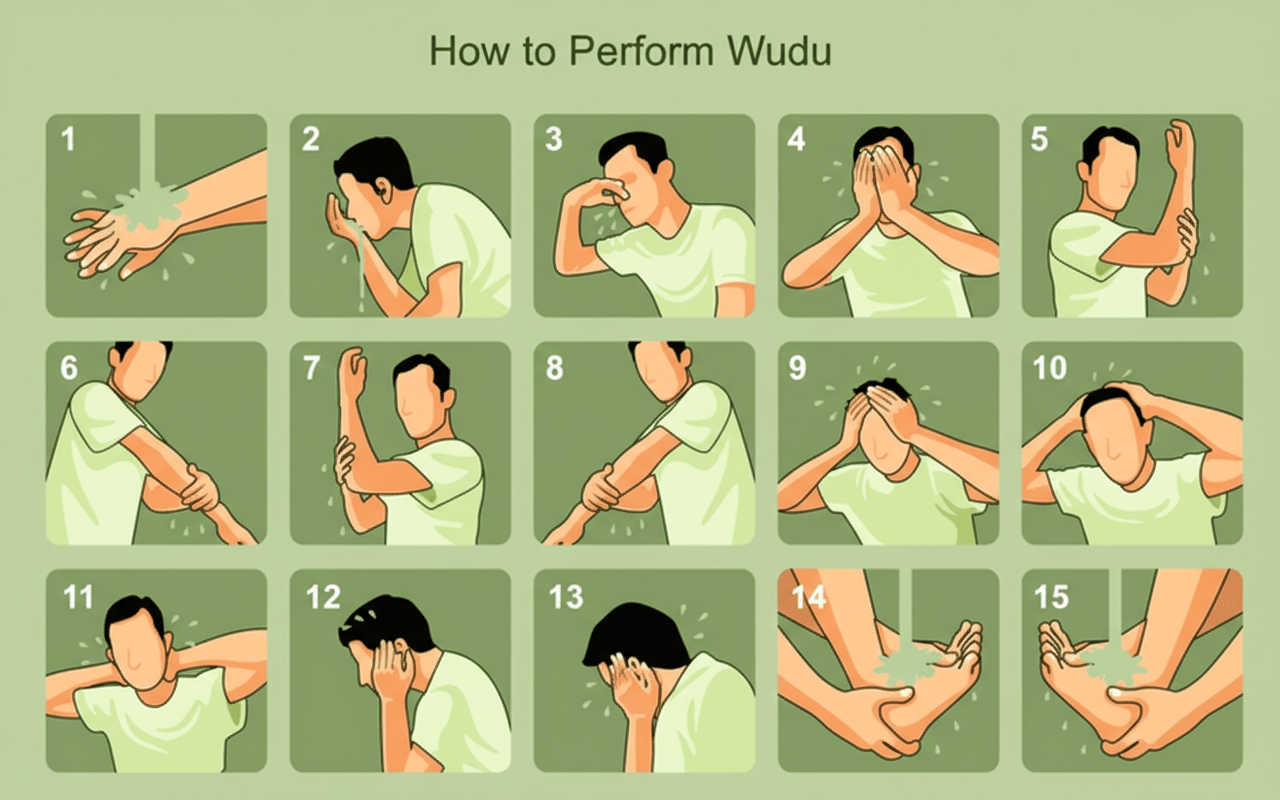
Step-by-Step Guide: How to Perform Wudu Properly (Hanafi)
Below is the simplest and most authentic beginner-friendly method.

Step 1: Make Your Intention (Niyyah)
Niyyah means to have the intention in your heart:
“I am performing wudu for the sake of Allah.”
You do not need to say it out loud.
Step 2: Say “Bismillah”
Start by saying:
Bismillah
(“In the name of Allah”)
This brings blessings into the act of purification.
Step 3: Wash Your Hands (Three Times)
This removes physical dirt and prepares you for the next steps.
- Wash your right hand up to the wrist three times.
- Then wash your left hand three times.
- Rub between your fingers.
Step 4: Rinse Your Mouth (Three Times)
Take water into your mouth using your right hand and rinse it well.
If you are fasting, rinse gently.
Otherwise, rinse thoroughly.
Step 5: Clean Your Nose (Three Times)
- Sniff a little water into your nose.
- Blow it out gently using your left hand.
This process is called istinshaaq.
Step 6: Wash Your Face (Three Times)
Wash your entire face:
- From your hairline to your chin.
- From ear to ear.
Make sure no area is left dry.
Step 7: Wash Your Arms (Three Times)
- Wash your right arm from fingertips to elbow three times.
- Then wash your left arm the same way.
Let water reach between fingers and the entire arm.
Step 8: Wipe Over Your Head (Masah)
This is different from washing.
- Wet your hands and gently wipe from the front of your head to the back.
- Then bring them forward again.
Masah only needs to be done once.
Step 9: Wipe Your Ears
Using the same wet hands:
- Wipe inside the ears with your index fingers.
- Wipe the back of ears using your thumbs.
This is also done once.
Step 10: Wash Your Feet (Three Times)
- Wash your right foot up to the ankles three times.
- Then wash your left foot.
Do not forget to:
- Clean between all toes
- Ensure ankles are washed completely
Your wudu is now complete!
Common Mistakes People Make During Wudu
Beginners often make these errors:
❌ Leaving some areas dry
Example: elbows, heels, neck area, or edges of the face.
❌ Washing too fast
Wudu should be calm and mindful.
❌ Using too much water
The Prophet ﷺ used very little water.
❌ Not following the exact order
In the Hanafi school, following the correct sequence is important.
Sunnahs of Wudu
These are recommended (not obligatory), but bring great reward:
- Using miswak before wudu
- Facing the Qibla
- Washing body parts three times each
- Performing wudu slowly and calmly
- Reciting the dua after finishing
Benefits of Wudu
Wudu is not just about physical cleanliness. It has spiritual and emotional benefits too.
⭐ Spiritual Benefits
- Increases khushu’ (concentration) in prayer
- Removes minor sins
- Strengthens connection with Allah
⭐ Mental & Emotional Benefits
- Refreshes your body and mind
- Helps reduce stress
- Creates a peaceful mindset before prayer
⭐ Physical Benefits
- Cleans the skin
- Improves hygiene
- Prevents infections
Wudu is a complete purification for body and soul.
Dua After Completing Wudu
The Prophet ﷺ taught this beautiful dua:
Arabic:
أَشْهَدُ أَنْ لَا إِلٰهَ إِلَّا اللَّهُ وَحْدَهُ لَا شَرِيكَ لَهُ، وَأَشْهَدُ أَنَّ مُحَمَّدًا عَبْدُهُ وَرَسُولُهُ
English Translation:
“I bear witness that there is no god but Allah, He is One and has no partner, and I bear witness that Muhammad is His servant and Messenger.”
Reward
The Prophet ﷺ said that the gates of Paradise open for the one who recites this after making wudu.
Conclusion
Wudu is one of the simplest yet most beautiful acts of worship in Islam. For new Muslims, it becomes a gateway to prayer, peace, and spiritual closeness to Allah.
By following this step-by-step beginner-friendly guide, you can perform wudu confidently and correctly according to the Hanafi school of thought.
If you wish to learn more basics of Islam, visit:
👉 thequranicacademy.com
FAQs: Wudu for Beginners
1. Does my wudu break if I touch my wife or husband?
No. According to the Hanafi school, touching your spouse does not break wudu.
2. Does bleeding break wudu?
Yes—if the blood flows out and reaches the skin.
3. Does crying break wudu?
No. Crying does not break wudu.
4. Do I need wudu to read Quran on phone?
No. Wudu is not required for reading from a phone app.
5. Can I dry my face with a towel after wudu?
Yes, drying is allowed.
6. If I sleep, does my wudu break?
If you fall asleep lying down, wudu breaks.
If you doze off while sitting, wudu stays valid.
7. Can I talk during wudu?
Yes, talking does not break wudu.
8. Can water go into my ears or nose too deep?
No. Use water gently—Islam teaches balance.
9. What if I forget one step of wudu?
Repeat that step and continue.
If you remember later, it is safer to perform full wudu again.
10. Can I do wudu with cold water?
Yes, as long as you can wash properly.