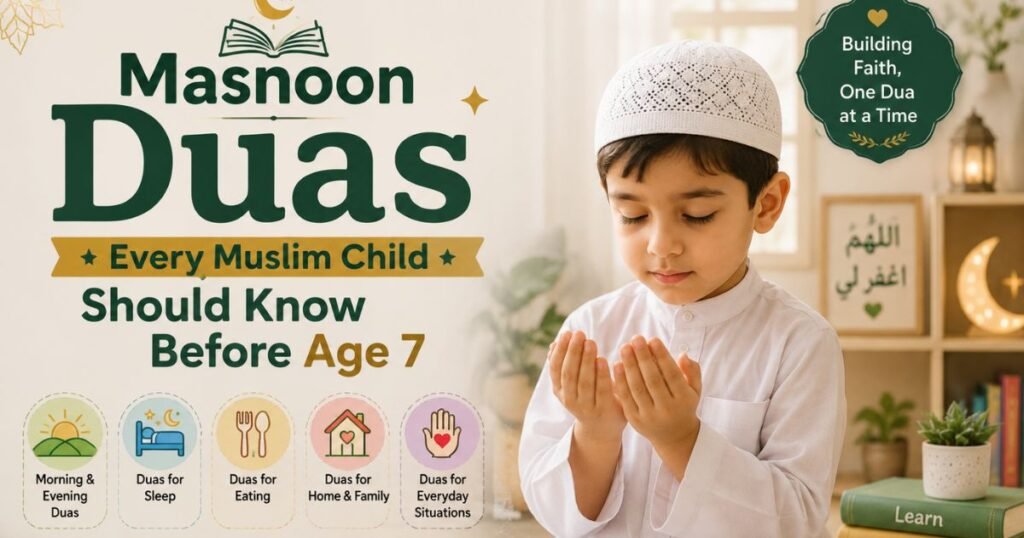


Every parent wants to raise a child who grows up with strong faith, good manners, and a close relationship with Allah. While teaching children how to read the Quran is an important responsibility, helping them memorize and understand Masnoon Duas is equally essential. These authentic supplications, taught by Prophet Muhammad ﷺ, guide Muslims through everyday activities and remind them to seek Allah’s help, mercy, and blessings in every situation.
The early years of a child’s life are the best time to build lifelong Islamic habits. By the age of seven, children have an incredible ability to memorize short duas and practice them naturally in their daily routine. Whether they are waking up in the morning, eating a meal, leaving the house, or going to bed, these simple supplications help them remember Allah throughout the day.
More importantly, teaching Masnoon duas is not just about memorization. It is about helping children understand that every blessing comes from Allah, every difficulty should be faced by turning to Him, and every moment of life is an opportunity to earn rewards through the Sunnah of Prophet Muhammad ﷺ.
In this guide, you’ll discover the most important Masnoon duas every Muslim child should know before the age of seven, along with their Arabic text, English meaning, authentic references, and practical tips for parents to make learning enjoyable.
Why Is It Important to Teach Masnoon Duas to Children?
Children learn by observing and repeating. The habits they develop in their early years often stay with them for life. When parents teach daily duas consistently, children begin to connect ordinary activities with the remembrance of Allah.
Instead of seeing Islam only as something practiced in the mosque, they learn that faith is part of every moment—from waking up in the morning to sleeping at night.
Allah says in the Quran:
فَاذْكُرُونِي أَذْكُرْكُمْ وَاشْكُرُوا لِي وَلَا تَكْفُرُونِ
“So remember Me; I will remember you. Be grateful to Me and do not deny Me.”
(Surah Al-Baqarah 2:152)
This beautiful verse teaches Muslims that remembering Allah brings His mercy and blessings. Teaching children daily duas helps them act upon this command from an early age.
The Prophet ﷺ also emphasized nurturing children with Islamic values. Parents are encouraged to introduce acts of worship gradually, making them a natural and enjoyable part of childhood rather than a burden.
Benefits of Learning Daily Duas Before Age Seven
Teaching Masnoon duas offers benefits that go far beyond memorization.
Children who regularly recite authentic supplications often develop:
- Strong love for Allah and His Messenger ﷺ
- Confidence in practicing Islam
- Gratitude for everyday blessings
- Better Islamic manners (Akhlaq)
- Awareness that Allah is always watching over them
- A habit of making dhikr throughout the day
- Emotional comfort during fear, sadness, or uncertainty
These daily reminders also strengthen the bond between parents and children, especially when families recite duas together before meals, bedtime, or traveling.
How Should Parents Teach Masnoon Duas?
Many parents make the mistake of asking children to memorize several duas at once. Young children learn much better through repetition than through pressure.
A simple routine can make a huge difference:
- Teach only one dua every week.
- Explain its meaning using easy words.
- Practice it every time the situation occurs.
- Encourage children instead of correcting them harshly.
- Repeat the dua together as a family.
For example, before every meal, remind your child to say “Bismillah.” Within a few weeks, it becomes second nature.
Consistency is always more effective than teaching too much too quickly.
1. Dua Before Eating
One of the first duas every Muslim child should learn is the dua before eating.
Arabic
بِسْمِ اللَّهِ
Transliteration
Bismillah
Meaning
“In the name of Allah.”
The Messenger of Allah ﷺ said:
“Young boy, mention the name of Allah, eat with your right hand, and eat from what is in front of you.”
Reference: Sahih al-Bukhari (5376) & Sahih Muslim (2022)
What Children Learn
This short dua teaches children:
- Food is a blessing from Allah.
- Every good action begins with Allah’s name.
- Following the Sunnah brings blessings into everyday life.
Even though it contains only one phrase, it is among the most important Islamic habits a child can develop.
2. Dua After Eating
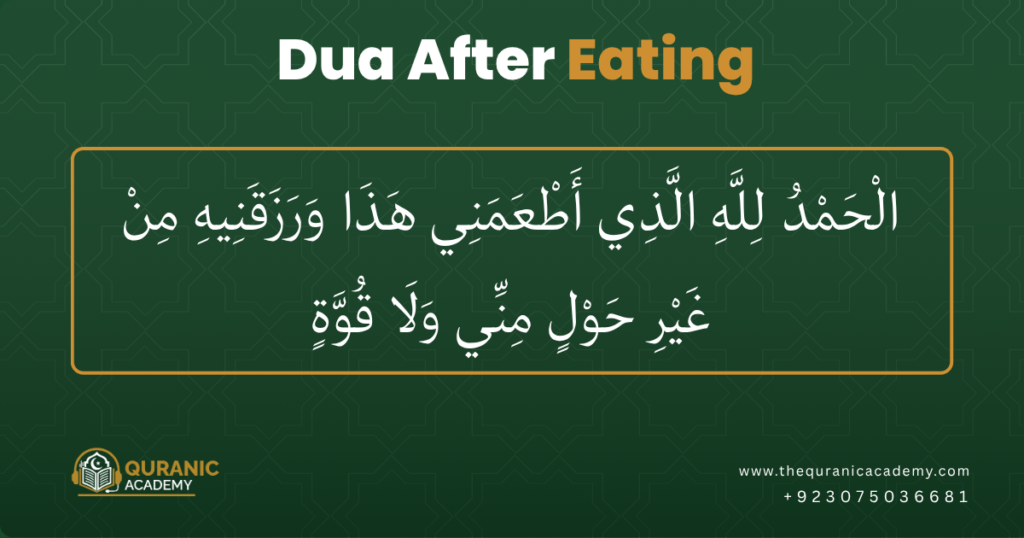
Children should also learn to thank Allah after finishing their meal.
Arabic
الْحَمْدُ لِلَّهِ الَّذِي أَطْعَمَنِي هَذَا وَرَزَقَنِيهِ مِنْ غَيْرِ حَوْلٍ مِنِّي وَلَا قُوَّةٍ
Transliteration
Alhamdu lillahil-ladhi at’amani hadha wa razaqanihi min ghayri hawlin minni wa la quwwah.
Meaning
“All praise is for Allah Who fed me this food and provided it for me without any power or strength from myself.”
Reference: Jami’ at-Tirmidhi (3458)
Teaching this dua helps children appreciate that every meal is a gift from Allah rather than something they deserve automatically.
3. Dua Before Sleeping
Bedtime is one of the best opportunities to teach children remembrance of Allah.
Arabic
بِاسْمِكَ اللَّهُمَّ أَمُوتُ وَأَحْيَا
Transliteration
Bismika Allahumma amutu wa ahya.
Meaning
“O Allah, in Your name I die and I live.”
Reference: Sahih al-Bukhari (6324)
Parents can make bedtime special by reciting this dua together every night.
It creates a peaceful routine while reminding children that Allah protects them even while they sleep.
4. Dua After Waking Up
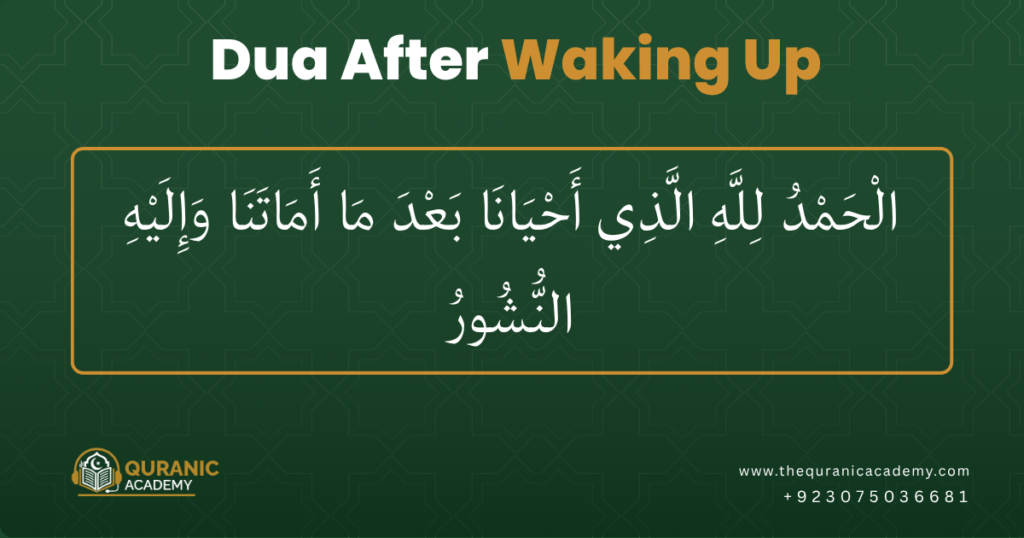
The first words a child says each morning should be words of gratitude.
Arabic
الْحَمْدُ لِلَّهِ الَّذِي أَحْيَانَا بَعْدَ مَا أَمَاتَنَا وَإِلَيْهِ النُّشُورُ
Transliteration
Alhamdu lillahil-ladhi ahyana ba’da ma amatana wa ilayhin-nushur.
Meaning
“All praise is for Allah Who gave us life after causing us to die, and to Him is the resurrection.”
Reference: Sahih al-Bukhari (6312)
This beautiful supplication teaches children to begin every new day with gratitude instead of rushing straight into their daily activities.
Helping Children Learn Correct Pronunciation
Many Muslim families, especially those living in countries where Arabic is not commonly spoken, find it difficult to teach proper pronunciation at home. While parents can introduce daily duas themselves, learning from qualified teachers helps children pronounce Arabic words correctly and understand their meanings.
Today, many families choose trusted online Quran classes for children where experienced teachers teach Masnoon duas alongside Noorani Qaida, Tajweed, and Quran reading in a structured and engaging way. Programs such as those offered by The Quranic Academy allow children to practice authentic daily supplications with proper pronunciation while building a strong Islamic foundation from an early age.
This balanced approach allows parents to reinforce the duas at home while ensuring children learn them accurately from knowledgeable instructors.
5. Dua Before Entering the Bathroom
Islam teaches Muslims to seek Allah’s protection even before entering places where impurities exist.
Arabic
اللَّهُمَّ إِنِّي أَعُوذُ بِكَ مِنَ الْخُبُثِ وَالْخَبَائِثِ
Transliteration
Allahumma inni a’udhu bika minal khubuthi wal khaba’ith.
Meaning
“O Allah, I seek refuge in You from male and female devils.”
Reference: Sahih al-Bukhari (142)
Teaching this dua helps children understand that Allah is their protector in every situation, no matter how ordinary it may seem.
6. Dua After Leaving the Bathroom
After leaving the bathroom, children should remember Allah once again.
Arabic
غُفْرَانَكَ
Transliteration
Ghufranak
Meaning
“I seek Your forgiveness.”
Reference: Sunan Abi Dawood (30)
Although this dua is very short, it teaches humility and reminds children that seeking Allah’s forgiveness should become a regular habit throughout life.
7. Dua Before Leaving Home
Every time a child steps outside, they enter an environment filled with different experiences and challenges. Islam teaches Muslims to seek Allah’s protection and place their trust in Him before leaving home.
Arabic
بِسْمِ اللَّهِ، تَوَكَّلْتُ عَلَى اللَّهِ، لَا حَوْلَ وَلَا قُوَّةَ إِلَّا بِاللَّهِ
Transliteration
Bismillahi, tawakkaltu ‘alallah, la hawla wa la quwwata illa billah.
Meaning
“In the name of Allah, I place my trust in Allah. There is no power and no strength except with Allah.”
Reference: Sunan Abi Dawood (5095), Jami’ at-Tirmidhi (3426)
The Prophet ﷺ informed us that the person who recites this dua is guided, protected, and safeguarded by Allah. Teaching this supplication helps children understand the importance of Tawakkul (trust in Allah) from a young age.
8. Dua When Entering the Home
A Muslim home should be filled with the remembrance of Allah. One beautiful Sunnah is remembering Allah when entering the house.
Arabic
بِسْمِ اللَّهِ وَلَجْنَا، وَبِسْمِ اللَّهِ خَرَجْنَا، وَعَلَى رَبِّنَا تَوَكَّلْنَا
Transliteration
Bismillahi walajna, wa bismillahi kharajna, wa ‘ala Rabbina tawakkalna.
Meaning
“In the name of Allah we enter, in the name of Allah we leave, and upon our Lord we place our trust.”
Reference: Sunan Abi Dawood (5096)
When children regularly recite this dua, they learn that every home should begin with the remembrance of Allah.
9. Quranic Dua for Seeking Knowledge
Education is highly valued in Islam. Before beginning school, Quran lessons, or homework, children can recite this beautiful Quranic supplication.
Arabic
رَبِّ زِدْنِي عِلْمًا
Transliteration
Rabbi Zidni ‘Ilma
Meaning
“My Lord, increase me in knowledge.”
Quran Reference: Surah Taha (20:114)
This short dua teaches children that knowledge is a gift from Allah and that every learning journey should begin by asking Him for guidance.
10. Dua for Parents
Respecting parents is one of the greatest teachings in Islam. Children should learn to make dua for those who care for them.
Arabic
رَبِّ ارْحَمْهُمَا كَمَا رَبَّيَانِي صَغِيرًا
Transliteration
Rabbi irhamhuma kama rabbayani saghira.
Meaning
“My Lord, have mercy upon them as they raised me when I was young.”
Quran Reference: Surah Al-Isra (17:24)
Teaching this dua develops gratitude, kindness, and respect toward parents.
Bedtime Sunnahs Every Child Should Learn
Besides memorizing short duas, parents should gradually introduce other authentic Sunnahs before sleeping.
These include:
- Reciting Ayatul Kursi.
- Reading Surah Al-Ikhlas, Surah Al-Falaq, and Surah An-Nas.
- Sleeping on the right side whenever possible.
- Performing wudu before sleeping if practical.
- Remembering Allah before closing the eyes.
The Prophet ﷺ regularly practiced these Sunnahs before sleeping and encouraged Muslims to do the same.
References:
- Sahih al-Bukhari (2311)
- Sahih al-Bukhari (5017)
Parents should teach these practices gradually rather than expecting children to learn everything at once.
Practical Tips for Parents to Make Dua Learning Easy
Children enjoy learning when lessons are interactive and connected to their daily routine. Instead of turning memorization into a test, make it part of everyday family life.
Some effective methods include:
Teach One Dua at a Time
Avoid overwhelming your child. Focus on one short supplication until they can confidently recite it.
Explain the Meaning
Even young children can understand simple explanations.
For example:
Instead of saying,
“Say Bismillah.”
Explain,
“We say Bismillah because Allah gave us this food.”
Understanding creates a stronger connection than memorization alone.
Practice Every Day
Repetition is the key to long-term memory.
Before every meal…
Before every bedtime…
Before leaving the house…
Repeat the same dua together.
Eventually, your child will begin saying it without reminders.
Be a Role Model
Children imitate their parents more than they follow instructions.
If they hear you remembering Allah throughout the day, they naturally develop the same habit.
Common Mistakes Parents Should Avoid
Many parents unintentionally make dua learning difficult.
Some common mistakes include:
- Asking children to memorize long duas immediately.
- Correcting mistakes harshly.
- Teaching Arabic without explaining the meaning.
- Practicing only occasionally instead of daily.
- Comparing one child with another.
Remember that every child learns at a different pace.
Encouragement and patience are far more effective than pressure.
Building Lifelong Islamic Habits
Teaching Masnoon duas before the age of seven is not about completing a checklist. It is about nurturing a heart that remembers Allah throughout the day.
As children grow older, these simple habits become the foundation for larger acts of worship such as Salah, Quran recitation, fasting, and making sincere dua during difficult times.
Parents who consistently encourage these small acts often see their children naturally develop confidence in practicing Islam.
Whether a family lives in a Muslim-majority country or abroad, creating a home where Allah is remembered every day gives children a strong Islamic identity that stays with them for life.
Frequently Asked Questions
How many Masnoon duas should a child know before the age of seven?
There is no fixed number in Islam. However, children should ideally memorize the essential daily duas, including those for eating, sleeping, waking up, leaving home, entering the home, and seeking knowledge. Learning around 10–15 authentic duas provides a strong foundation.
Should children understand the meaning of the duas?
Yes. Understanding the meaning helps children develop love for Allah instead of simply memorizing Arabic words. Parents should explain each dua using language that matches the child’s age.
Can parents teach Masnoon duas at home?
Absolutely. Parents play the primary role in introducing these supplications. However, if they need support with Arabic pronunciation or Tajweed, qualified teachers can provide additional guidance while parents continue reinforcing the lessons at home.
Why is learning Masnoon duas important before age seven?
Early childhood is the best time for building habits. When children learn daily duas before the age of seven, remembering Allah becomes a natural part of their routine as they grow older.
Final Thoughts
The greatest gift parents can give their children is not only a good education but also a strong connection with Allah. Teaching Masnoon duas from an early age helps children understand that Islam is not limited to the mosque or the Quran lesson—it is a way of life that guides every action, from waking up in the morning to going to sleep at night.
By introducing one dua at a time, explaining its meaning, and practicing it consistently, parents can nurture faith, gratitude, and excellent character in their children. These small daily supplications may seem simple, but they leave a lasting impact on a child’s heart and strengthen their relationship with Allah throughout their life.
May Allah ﷻ bless our children with beneficial knowledge, sincere faith, righteous character, and the ability to follow the beautiful Sunnah of Prophet Muhammad ﷺ. Ameen.