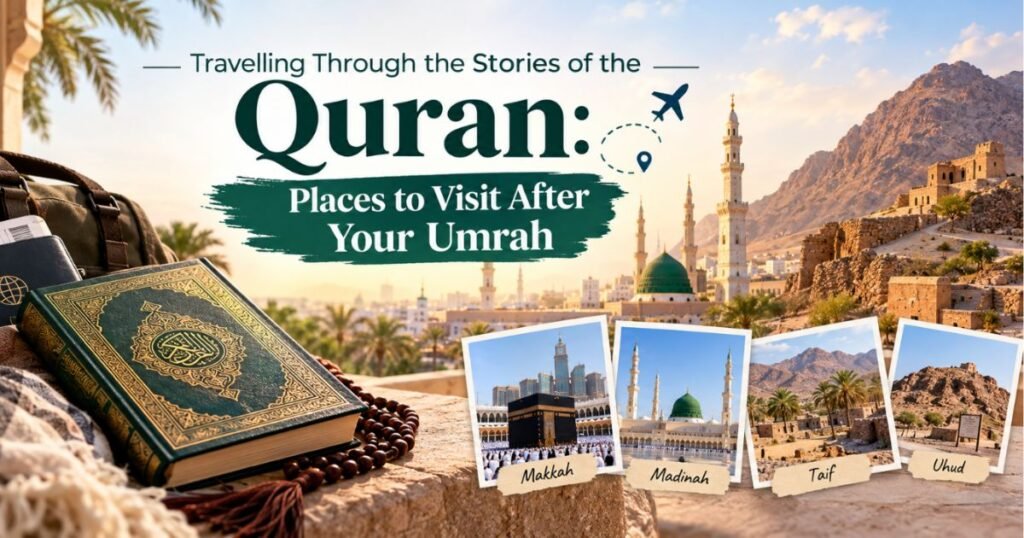


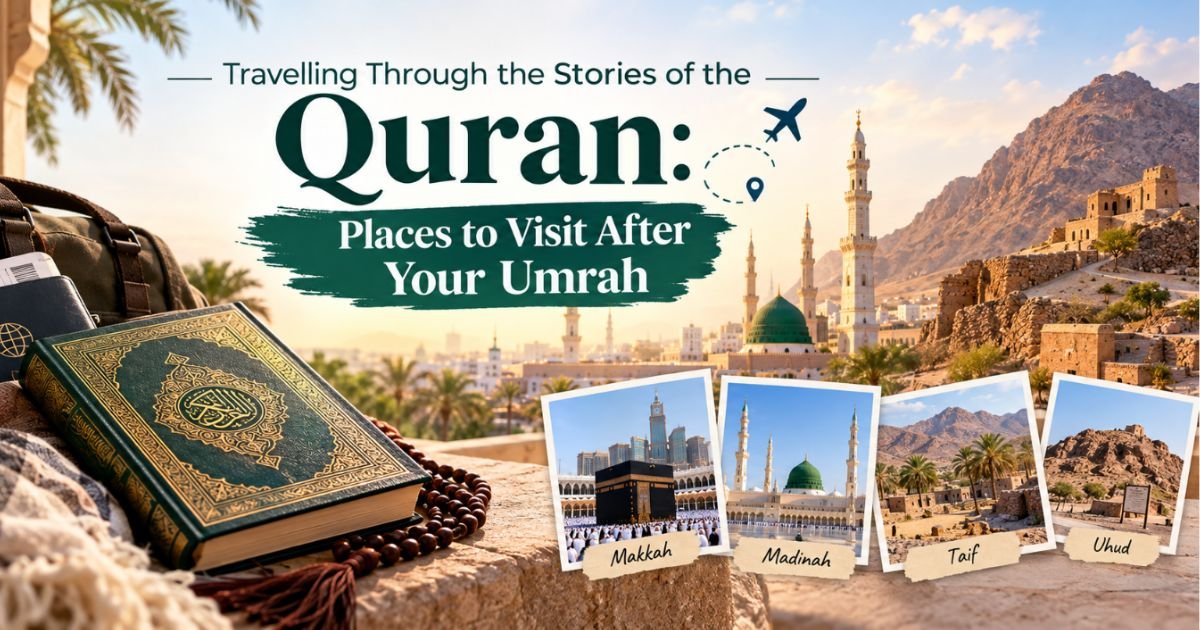
Anyone who has studied the Quran closely knows how much of it is set in real places. Valleys, mountains, ancient cities and the remains of nations that came before are all mentioned, and many of them can still be visited today. For British Muslims who have spent years learning to read, memorise or understand the Quran, seeing some of these places in person can make familiar verses come alive.
Most people start with the most important journey of all, to Makkah and Madinah. Many book umrah packages all-inclusive of flights, visa, hotels and transfers, and then wonder whether they could add a few days somewhere else. This guide looks at places linked to the stories of the Quran that pilgrims from the UK can visit, either alongside Umrah or as a separate trip, and how to plan them sensibly.
Which Quran-linked places can you visit?
- Makkah and Madinah: the places of revelation and the life of the Prophet.
- AlUla and Hegra in Saudi Arabia, traditionally linked by many to the people of Thamud.
- Jordan, home to a cave many associate with the People of the Cave.
- Egypt, with places connected to the story of Prophet Musa.
- Always check travel advice on GOV.UK before planning any extra destination.
Makkah and Madinah: where the story begins
Before going anywhere else, it’s worth slowing down in the holy cities. In Makkah, Jabal al-Nour holds the Cave of Hira, where the first verses of the Quran were revealed. The Hira Cultural District at the foot of the mountain has an exhibition about the revelation, which is ideal if you can’t manage the steep climb.
In Madinah, Masjid Quba, the first mosque built in Islam, is mentioned in the Quran as a mosque founded on piety, according to many scholars of tafsir. Mount Uhud recalls the battle described in Surah Al Imran. Reading those passages before you visit gives them a depth no guidebook can match.
AlUla and Hegra: the rock-cut tombs of the north
In the north-west of Saudi Arabia lies AlUla, home to Hegra, a UNESCO World Heritage Site with monumental tombs carved into sandstone outcrops. Many Muslims associate the area with Al-Hijr and the people of Thamud, who are described in the Quran as carving homes from the mountains. Historians link the surviving tombs mainly to the Nabataeans, so it’s fair to say the connection is traditional rather than proven. Either way, standing among the carved rock faces while recalling the verses about Thamud is a powerful reminder of how great civilisations can disappear.
Because it’s in Saudi Arabia, AlUla can sometimes be added to an Umrah trip with a domestic flight. The tourist eVisa allows travel around the country, but check the latest rules and whether your visa type covers tourism as well as Umrah.
Jordan: the cave of the sleepers
Surah Al-Kahf tells the story of young believers who took refuge in a cave and slept for many years. Several places in the region have been linked to the story. One of the best-known is a cave near Amman in Jordan, often called the Cave of the Seven Sleepers. Scholars don’t agree on the exact location, so treat it as a site of reflection rather than a certainty.
Jordan has a lot more to offer pilgrims, including shrines of companions of the Prophet and, of course, Petra. Many families combine a few days in Jordan with a separate trip, or travel there before or after Umrah.
Egypt: following the story of Musa
Prophet Musa is mentioned more often by name in the Quran than any other prophet. Egypt, the land of Pharaoh, is central to his story. Many visitors travel to Mount Sinai in the south of the Sinai Peninsula, traditionally identified with the mountain where Musa received revelation, and climb it before dawn to see the sunrise. Cairo itself is full of historic mosques and Islamic architecture.
Travel advice for parts of Egypt can change, so check GOV.UK carefully before booking anything.
Choosing affordable faith-based trips
Not every journey needs to be expensive. Cheap Islamic Holiday Packages have become more common as travel firms see growing demand from Muslim families who want trips with halal food, prayer time built into the schedule and a focus on Islamic history. These range from short city breaks in Istanbul or Cairo to longer tours of Jordan or Morocco. The best value usually comes from travelling outside school holidays and booking a few months ahead.
Whatever you book, make sure the company is properly licensed. In the UK, packages that include flights should be ATOL protected, which you can check on the Civil Aviation Authority website.
How to prepare spiritually
These trips are most meaningful when you arrive with the verses already in your heart. Before you travel:
- Read the relevant passages, with translation and tafsir. For example, Surah Al-Kahf for the People of the Cave, and the passages on Thamud in Surah Al-A’raf and Surah Al-Hijr.
- Take a short course on the stories of the prophets, or ask your Quran teacher to go through them with you.
- Write down a few reflections or duas you want to make at each place.
- Teach the stories to your children before the trip, so they understand what they’re seeing.
Practical tips
- Check visa requirements for every country, not just Saudi Arabia.
- For Umrah, you’ll need a meningococcal ACWY vaccination and an Umrah permit from the Nusuk app.
- Take out travel insurance that covers every country on your route.
- Respect local rules at historic sites, especially on photography and dress.
- Don’t treat claimed locations as certain where scholars disagree.
Frequently asked questions
Can I visit AlUla on the same trip as Umrah?
Often, yes, with a domestic flight. Check that your Saudi visa allows tourist travel as well as Umrah.
Where is the Cave of the People of the Cave?
Several places are linked to the story, including a cave near Amman in Jordan. Scholars differ on the exact location.
Are Islamic holiday packages ATOL protected?
Packages sold in the UK that include flights should be. Check the firm’s licence on the CAA website.
How can I prepare for these trips?
Read the relevant Quranic passages with translation and tafsir before you travel.
Key takeaways
- Many places linked to Quranic stories can be visited today.
- Some locations are traditional associations rather than proven sites.
- Reading the verses beforehand makes each visit far more meaningful.
- Check travel advice and book with an ATOL-protected firm.
The Quran often invites its readers to travel through the land and reflect on what came before. For British Muslims, a pilgrimage to Makkah and Madinah, followed by a visit to one of these places, can be a way of answering that invitation, and of returning home with the stories of the Quran closer to the heart than ever.
Sources and further reading
UNESCO World Heritage listing for Hegra (Al-Hijr); GOV.UK foreign travel advice for Saudi Arabia, Jordan and Egypt; the official Nusuk platform; classical tafsir works on Surah Al-Kahf and the passages on Thamud.