



Memorizing the Quran is one of the most beautiful and rewarding journeys a Muslim can undertake. For many students, however, the biggest question is simple: How can I memorize the Quran fast without forgetting what I have already learned?
The answer is not simply to memorize more pages every day. In my experience teaching Quran and helping students with Hifz, the students who make the best progress are not necessarily those who memorize the most in one sitting. They are the ones who follow a consistent routine, revise properly, recite with accuracy, and gradually build strong memory.
If you want to learn how to memorize Quran quickly, the goal should not be speed alone. Your goal should be fast, accurate, and lasting memorization.
This guide explains practical Quran memorization techniques that can help children, adults, beginners, and serious Hifz students develop a stronger and more sustainable memorization routine.
What Does It Really Mean to Memorize the Quran Fast?
When people search for how to memorize Quran fast, they often imagine memorizing one or two pages every day and completing the Quran in the shortest possible time.
But memorizing quickly and memorizing correctly are two different things.
A student may memorize several pages in a week but forget most of them a few weeks later. Another student may memorize less but retain every portion strongly for years.
The second student is actually making better progress.
A good Hifz routine has three important qualities:
- Accuracy – The verses are memorized with correct pronunciation and Tajweed.
- Retention – Previously memorized portions remain strong through regular revision.
- Consistency – The student continues memorizing and revising every day.
This is why the best way to memorise Quran is not to rush. It is to create a system that allows you to make steady progress without sacrificing accuracy.
How Long Does It Take to Memorize the Quran?
There is no single answer because every student’s circumstances are different.
The time required depends on several factors, including:
- Age and memory ability
- Previous Quran reading experience
- Tajweed and pronunciation
- Daily study time
- Concentration
- Quality of revision
- Support from a qualified Quran teacher
- Consistency
- The amount of Quran memorized each day
For example, a student who can dedicate several focused hours to Hifz may progress faster than someone who only has 30 minutes available each day.
Children who attend school may need a different schedule from adults who work full-time. Likewise, a beginner who is still improving Quran reading should not be expected to follow the same memorization target as an experienced reader.
The important thing is to establish a realistic target and maintain it.
One page memorized strongly is better than three pages memorized weakly.
How to Memorize Quran Quickly: 10 Proven Techniques
1. Set a Fixed Time for Quran Memorization
One of the simplest ways to improve your memorization speed is to study at the same time every day.
Your brain becomes accustomed to the routine, and you spend less time deciding when to study.
For many students, the early morning is an excellent time because the mind is fresh and there are usually fewer distractions. Others may find that an evening session works better because of their school or work schedule.
The exact time matters less than consistency.
Choose a time that you can realistically maintain every day.
2. Make Sure Your Quran Reading Is Correct
Before trying to memorize large portions, make sure you can read the Quran correctly.
Incorrect pronunciation can become deeply attached to memory when a student repeatedly memorizes an ayah incorrectly. Correcting it later may require considerably more effort.
This is especially important for beginners.
Students who struggle with Arabic letters, Makharij, or basic Tajweed should strengthen their Quran reading before increasing their Hifz target.
If necessary, spend some time improving your reading and Tajweed first. Strong reading skills make memorization easier and more reliable.
3. Understand the Meaning of What You Memorize
You do not need to become a scholar before starting Hifz, but understanding the general meaning of the verses can make memorization easier.
When you understand what an ayah is discussing, the words are no longer just a sequence of sounds. They become connected ideas.
For example, if several verses describe a particular event, command, warning, or story, understanding the subject can help you remember the order of the verses.
Use a reliable English translation or explanation alongside your memorization when appropriate.
However, remember that your primary memorization session should remain focused. Do not allow lengthy study of explanations to replace your actual Hifz practice.
4. Listen to the Same Recitation Repeatedly
Listening is an extremely useful support for Quran memorization.
Choose a reliable Qari whose recitation is clear and easy for you to follow. Listen to the same passage repeatedly before or after your memorization session.
Repeated listening helps you become familiar with:
- Pronunciation
- Verse endings
- Rhythm
- Pauses
- Similar phrases
- The sequence of verses
Do not constantly switch between many different reciters while learning the same passage. Consistency makes it easier for your ears to recognize the correct sequence.
5. Break the Ayah Into Small Sections
Trying to memorize an entire page in one attempt can overwhelm your memory.
Instead, divide the passage into smaller portions.
Read the first phrase several times while looking at the Mushaf. Then recite it without looking.
Once it is strong, add the next phrase.
Then connect the two.
Continue this process until you can recite the complete ayah.
This simple approach is particularly helpful for beginners and students who ask how to memorise Quran easily.
6. Use the Look, Read, Repeat, Recite Method
A practical memorization cycle is:
Look → Read → Repeat → Recite → Check
First, look carefully at the Mushaf.
Read the passage slowly and correctly.
Repeat it several times.
Close or move your eyes away from the Mushaf and recite it from memory.
Then check yourself against the Mushaf.
If you make an error, do not simply continue. Identify the mistake, look at the correct wording, repeat it, and test yourself again.
This creates active recall rather than passive reading.
7. Recite Without Looking
Reading the same page repeatedly while looking at it may create a false feeling that you have memorized it.
True memorization becomes clear when you can recite without looking.
After learning a section, put the Mushaf aside and test yourself.
Ask yourself:
- Can I start the ayah without looking?
- Can I continue if someone stops me in the middle?
- Can I connect this ayah to the next one?
- Can I remember the similar phrases?
- Can I recite the whole passage without hesitation?
If the answer is no, the passage needs more repetition.
8. Use Your Memorized Quran in Salah
One of the most effective ways to remember Quran is to use memorized portions in your prayers.
When you recite what you have memorized in Salah, you are using the verses in a different setting from your normal study session.
This gives your memory additional reinforcement.
Short Surahs and recently memorized passages can be particularly useful for this purpose.
Remember, however, that accuracy is essential. Do not deliberately recite a portion in Salah that you have not yet memorized properly.
9. Keep the Same Mushaf
Changing between different copies of the Quran can sometimes make visual memorization more difficult.
Many students remember not only the words but also their approximate position on the page.
The location of an ayah, the beginning of a page, and the visual arrangement of the text can become useful memory cues.
For this reason, try to use the same Mushaf consistently throughout your memorization journey.
10. Have a Qualified Teacher Check Your Recitation
Self-study can be useful, but Hifz is much stronger when a qualified teacher regularly listens to your recitation.
A teacher can identify:
- Pronunciation errors
- Tajweed mistakes
- Weak memorization
- Incorrect verse connections
- Similar ayahs that are being confused
- Portions that require additional revision
A teacher also provides accountability.
When someone is expecting you to prepare your lesson, it becomes much easier to maintain discipline.
The Best Way to Memorise Quran: Sabaq, Sabqi and Manzil
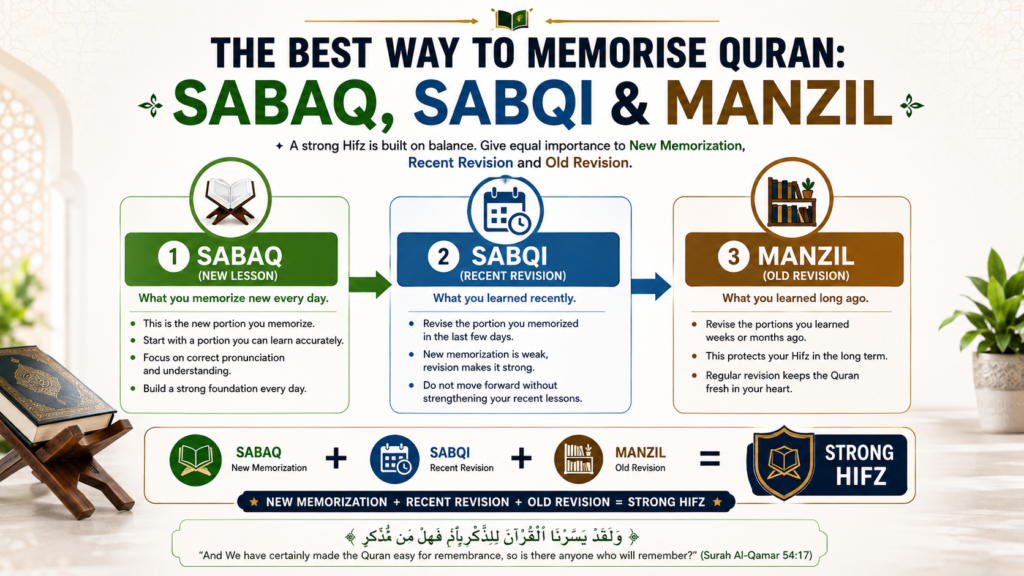
One of the most important principles in successful Hifz is maintaining a balance between new memorization and revision.
A traditional Hifz structure commonly divides the work into three parts:
Sabaq: Your New Lesson
Sabaq is the new portion you are memorizing.
This could be a few lines, half a page, or more depending on your ability.
Do not choose your target simply because another student is memorizing more.
Your Sabaq should be challenging enough to create progress but manageable enough that you can recite it accurately.
Sabqi: Recent Revision
Sabqi refers to the recently memorized portion.
This is extremely important because newly memorized Quran is usually more vulnerable to forgetting.
For example, after learning today’s lesson, you should continue revising previous lessons instead of immediately forgetting them while moving forward.
This creates a bridge between your old and new memorization.
Manzil: Older Revision
Manzil is the revision of your older memorized Quran.
This is what protects your Hifz in the long term.
Many students make a serious mistake: they become very good at memorizing new pages but weak at revising old ones.
Eventually, they reach a point where they have memorized many Juz but cannot confidently recite them.
The solution is simple:
New memorization must always be accompanied by old revision.
How to Memorize Quran Easily Without Forgetting
If your goal is not only to memorize Quran but also to remember Quran for years, revision should receive as much attention as new memorization.
Here are some practical habits:
- Revise yesterday’s lesson before starting today’s lesson.
- Regularly revise older portions.
- Recite memorized Surahs in Salah.
- Listen to portions you have already memorized.
- Ask your teacher to test you randomly.
- Mark difficult or frequently forgotten passages.
- Reduce your new lesson when your revision becomes weak.
Sometimes the fastest way to move forward is actually to slow down for a few days and strengthen weak portions.
Strong foundations save time later.
A Practical Daily Quran Memorization Routine
A simple routine can make your Hifz much easier.
Morning: New Memorization
Start with your new Sabaq when your mind is fresh.
Read the passage correctly, divide it into sections, repeat each section, and then connect the complete passage.
During the Day: Short Repetition
You do not need another long study session every time.
Use short periods to repeat what you learned.
You can recite while walking, during a quiet break, or at another suitable time.
Evening: Revision
Review your new lesson again.
Then revise your recent and older portions according to your Hifz schedule.
Before Sleeping: Final Recall
Try to recite the day’s lesson without looking.
This gives you another opportunity to identify weak areas before the next day.
A 60-Minute Hifz Study Plan
If you have approximately one hour available, you can divide it like this:
10 minutes: Recent revision
25 minutes: New memorization
15 minutes: Repetition and connection
10 minutes: Recitation without looking
This is only an example. Your teacher can adjust the routine according to your age, ability, and memorization target.
The important thing is that the session should contain both new learning and revision.
How to Memorize Quran Quickly for Beginners
Beginners should not feel pressured to memorize large portions immediately.
First, make sure you can:
- Recognize Arabic letters
- Pronounce the letters correctly
- Read words comfortably
- Apply basic Tajweed
- Follow the Mushaf correctly
Then begin with manageable portions.
Short Surahs from Juz Amma can be a good starting point for many beginners because they provide achievable milestones and help build confidence.
As your reading and memory improve, your daily target can gradually increase.
Remember:
Do not measure your Hifz by pages alone. Measure it by how accurately you can recite those pages without looking.
How Adults Can Memorize the Quran Easily
Adults can absolutely memorize the Quran.
The main challenge for many adults is not lack of ability but lack of uninterrupted time.
Work, family responsibilities, studies, and other commitments can make long study sessions difficult.
The solution is to build Hifz around your lifestyle.
For example, an adult may benefit from:
- A shorter daily target
- Fixed memorization times
- Early morning study
- Short revision sessions throughout the day
- Listening during suitable periods
- Online one-on-one Quran lessons
- A teacher who monitors progress
Adults should also avoid comparing their progress with young students.
Your goal is not to compete with someone else. Your goal is to remain consistent with your own journey.
How Parents Can Help Children Memorize Quran Faster
Parents play an important role in a child’s Hifz journey.
Children generally perform better when Quran memorization becomes a positive part of their routine rather than something they constantly fear.
Parents can help by:
Creating a Consistent Schedule
Children should know when their Quran lesson and revision time takes place.
Providing a Quiet Environment
Remove unnecessary distractions during the memorization session.
Encouraging Instead of Constantly Criticizing
Correction is necessary, but excessive criticism can reduce motivation.
Listening to Their Recitation
Parents can ask the child to recite the day’s lesson and encourage them to revise previous portions.
Communicating With the Teacher
Regular communication helps parents understand where the child is progressing and where additional support is needed.
Celebrating Progress
A child who feels that their effort is appreciated is more likely to continue.
The objective should be to develop a lifelong relationship with the Quran, not simply to finish Hifz as quickly as possible.
Common Mistakes That Slow Down Quran Memorization
Memorizing Too Much
A large daily target can become difficult to maintain.
Ignoring Revision
This is probably one of the biggest reasons students forget their Hifz.
Memorizing With Incorrect Pronunciation
Mistakes become harder to correct once they are deeply memorized.
Changing the Mushaf Frequently
Visual consistency can be helpful for many students.
Skipping Days
Missing one day can easily become several days. A smaller daily session is usually better than an unrealistic routine that frequently breaks.
Comparing Yourself With Other Students
Everyone has different circumstances and different memory strengths.
Moving Forward With Weak Memorization
Never assume that a weak lesson will somehow become stronger automatically.
Strengthen it before adding too much new material.
How to Remember Quran After Memorizing It
Completing Hifz is not the end of Quran memorization.
It is the beginning of a lifelong responsibility to maintain what Allah has allowed you to memorize.
A student who completes the Quran but stops revising may gradually lose fluency.
To maintain your Hifz:
- Keep a regular Manzil schedule.
- Recite older portions frequently.
- Use memorized Surahs in Salah.
- Ask a teacher to test you.
- Identify weak Juz before they become weaker.
- Continue listening to Quran.
- Do not allow long gaps in revision.
Think of Hifz like maintaining a valuable skill. It becomes stronger through regular use.
Can You Memorize the Quran Without a Teacher?
Technically, a person can memorize portions of the Quran independently, especially if they already have strong reading and Tajweed skills.
However, completing serious Hifz without qualified supervision can create problems.
A teacher provides three things that self-study often lacks:
Correction, accountability, and structure.
A teacher can hear mistakes that you may not notice yourself.
This is especially important because memorization and pronunciation are closely connected. If an error becomes part of your memory, correcting it later can be difficult.
For students who want to memorize the entire Quran, a structured Hifz program with regular teacher supervision is therefore highly beneficial.
Quran Memorization Techniques That Actually Work
The most useful techniques are not complicated.
Spaced Repetition
Review the same material at increasing intervals instead of studying it only once.
Active Recall
Try to recite without looking instead of repeatedly reading from the Mushaf.
Repetition
Repeat difficult passages until they become natural.
Auditory Learning
Listen to a reliable Qari repeatedly.
Visual Learning
Use the same Mushaf and pay attention to the position of verses on the page.
Verse Linking
Learn how the end of one ayah connects to the beginning of the next.
Recitation in Salah
Use memorized portions in prayer to reinforce them.
Regular Testing
Ask someone to listen to your recitation and stop you at different points.
These techniques work best when combined with a structured revision system.
What Should You Do If You Keep Forgetting What You Memorized?
First, do not become discouraged.
Forgetting does not necessarily mean that you are incapable of memorizing Quran. It often means that your revision system needs improvement.
Ask yourself:
Am I taking too much new Sabaq?
If yes, reduce it temporarily.
Am I revising older portions regularly?
If not, increase your Manzil.
Am I reciting without looking?
If not, include more active recall.
Am I learning with correct pronunciation?
If you are unsure, ask a qualified teacher to listen.
Sometimes the best solution is to temporarily reduce new memorization and spend several days strengthening older portions.
How Many Pages of Quran Should You Memorize Per Day?
There is no universal number that every student should follow.
One student may be able to memorize a page accurately every day. Another may need several days for the same page.
Both can succeed.
A practical starting point might be:
- Beginners: a few lines
- Developing students: several lines or half a page
- Strong students: around one page or more, depending on retention
These are not strict rules.
Your correct target is the amount you can memorize accurately while maintaining your revision.
If increasing your daily target causes your previous memorization to become weak, the target is too high.
A 30-Day Quran Memorization Plan
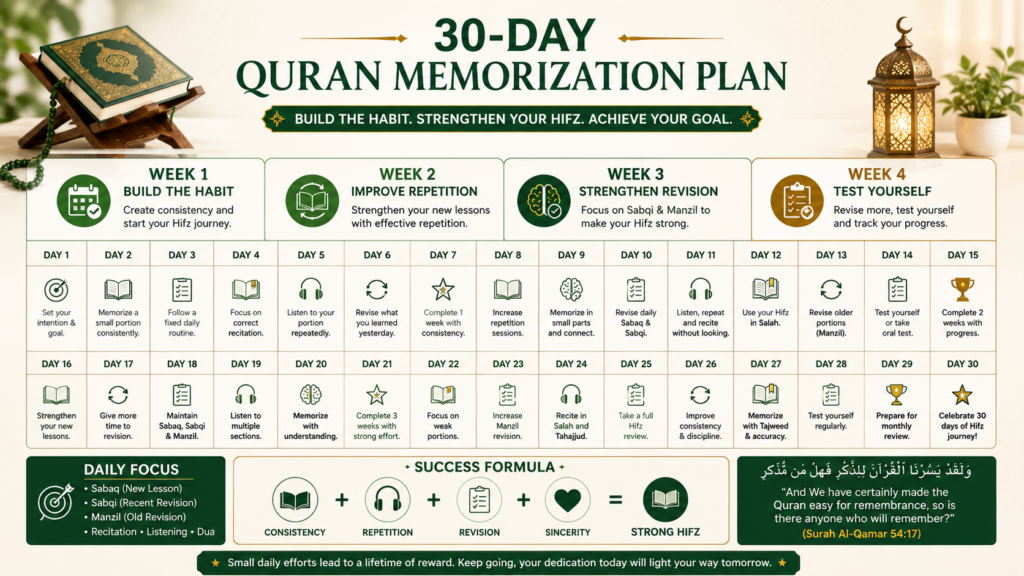
The first month should focus on building a system rather than chasing an impressive number of pages.
Week 1: Build the Habit
Choose a fixed time and establish your daily memorization routine.
Focus on correct pronunciation and manageable portions.
Week 2: Improve Repetition
Increase your use of active recall.
Try to recite more without looking at the Mushaf.
Week 3: Strengthen Revision
Begin giving more attention to recent and older portions.
Do not allow your revision to fall behind.
Week 4: Test Yourself
Ask your teacher or memorization partner to test you.
Identify weak passages and strengthen them before increasing your daily target.
At the end of 30 days, your biggest achievement should be a sustainable routine.
Islamic Principles That Help With Quran Memorization
Quran memorization is not only a memory exercise. It is an act of worship.
Therefore, the spiritual side of Hifz should not be ignored.
Keep Your Intention Sincere
Learn the Quran for the sake of Allah, not merely for praise, competition, or recognition.
Make Dua
Ask Allah to make the Quran easy for you, to strengthen your memory, and to allow you to act upon what you learn.
Respect the Quran
Approach your memorization with adab and seriousness.
Avoid Unnecessary Distractions
A distracted mind struggles to retain information.
Stay Consistent
Small but regular efforts are far more sustainable than occasional intense sessions.
Allah says:
“And We have certainly made the Qur’an easy for remembrance, so is there anyone who will remember?”
Surah Al-Qamar 54:17
This verse gives a powerful reminder that Allah has made the Quran accessible for remembrance. A student should therefore combine sincere effort with reliance upon Allah.
The Prophet ﷺ also said:
“The best of you are those who learn the Qur’an and teach it.”
The journey of learning and memorizing the Quran is therefore an honor in itself.
When Should You Consider Joining a Quran Memorization Course?
If you repeatedly struggle with consistency, forget what you memorize, or are unsure whether your recitation is correct, structured guidance can make a significant difference.
A good Hifz program should provide:
- A personalized memorization target
- Qualified Quran teachers
- Correct Tajweed and pronunciation
- Daily Sabaq
- Regular Sabqi
- Manzil revision
- Progress monitoring
- Regular assessments
- Flexible scheduling
- Individual attention
At The Quranic Academy, the Quran Memorization Course is structured around personalized Hifz plans, daily new memorization, regular Sabaq/Sabqi/Manzil revision, Tajweed, and long-term retention. The program provides one-on-one online classes and flexible scheduling for students in different parts of the world.
Students can learn more about the Quran Memorization Course and its structured Hifz approach before deciding whether it is suitable for them.
The academy also provides online Quran learning for children and adults who need structured guidance according to their level and goals.
Frequently Asked Questions About Quran Memorization
How can I memorize the Quran fast?
The fastest sustainable method is to combine a realistic daily Sabaq with strong revision, active recall, repeated listening, correct Tajweed, and regular teacher supervision. Increasing the amount of new memorization without revision usually leads to forgetting.
How can I memorize Quran quickly?
Set a fixed daily schedule, memorize small sections, repeat them frequently, recite without looking, and revise previous portions every day. Consistency is more important than trying to memorize an unrealistic amount in one session.
What is the best way to memorise Quran?
The best method combines Sabaq, Sabqi, and Manzil with accurate recitation, repetition, active recall, and regular testing by a qualified Quran teacher.
How can I memorise Quran easily?
Start with manageable portions, understand the general meaning, listen to the same recitation, use one Mushaf consistently, and establish a fixed daily routine.
How many pages should I memorize a day?
There is no fixed number. Your daily target should depend on your age, ability, schedule, reading level, and retention. It is better to memorize half a page strongly than one or two pages weakly.
How long does it take to memorize the Quran?
The timeline varies from student to student. A consistent student with strong reading skills may progress considerably faster than someone with limited daily time. The important goal is accurate and lasting memorization rather than an arbitrary deadline.
Can adults memorize the Quran?
Yes. Adults can memorize the Quran with a realistic schedule, consistent revision, and qualified guidance. Many adults simply need to adapt Hifz around work and family responsibilities.
Can I memorize the Quran without a teacher?
It is possible to memorize portions independently, but a qualified teacher is highly recommended for serious Hifz because they can correct pronunciation, monitor retention, provide accountability, and structure your revision.
How do I stop forgetting what I memorized?
Increase your revision, reduce new memorization temporarily if necessary, use active recall, recite in Salah, and ask a teacher to test your older portions regularly.
What is the best time of day to memorize Quran?
Many students find early morning effective because the mind is fresh and distractions are fewer. However, the best time is ultimately the time you can consistently protect for focused Quran study.
Is it better to memorize one page or half a page every day?
It depends on your ability. If half a page can be memorized and retained accurately, it is better than forcing yourself to memorize a full page and forgetting it later.
How much Quran should I revise each day?
Your revision amount should increase as your memorized portion grows. A serious Hifz student needs a structured revision system that includes recent and older portions rather than relying only on occasional revision.
Final Thoughts: Memorize the Quran With Speed, Strength, and Sincerity
If you are searching for how to memorize Quran fast, remember that real success is not measured by how many pages you can memorize in one day.
It is measured by how much Quran remains strong in your heart months and years later.
The most effective approach is simple:
Memorize a manageable amount.
Repeat it properly.
Recite without looking.
Revise what you already know.
Maintain Sabaq, Sabqi, and Manzil.
Learn with correct Tajweed.
Stay consistent.
And most importantly, seek Allah’s help throughout the journey.
Whether you are a parent helping your child, an adult beginning Hifz, or a student already memorizing several Juz, do not become discouraged by slow days. Every correctly memorized ayah is valuable.
The Quran is not a race to finish. It is a lifelong companion.
If you need structured guidance, personalized memorization targets, regular revision, and one-on-one support, explore the Quran Memorization Course at The Quranic Academy and take the next step in your Hifz journey.