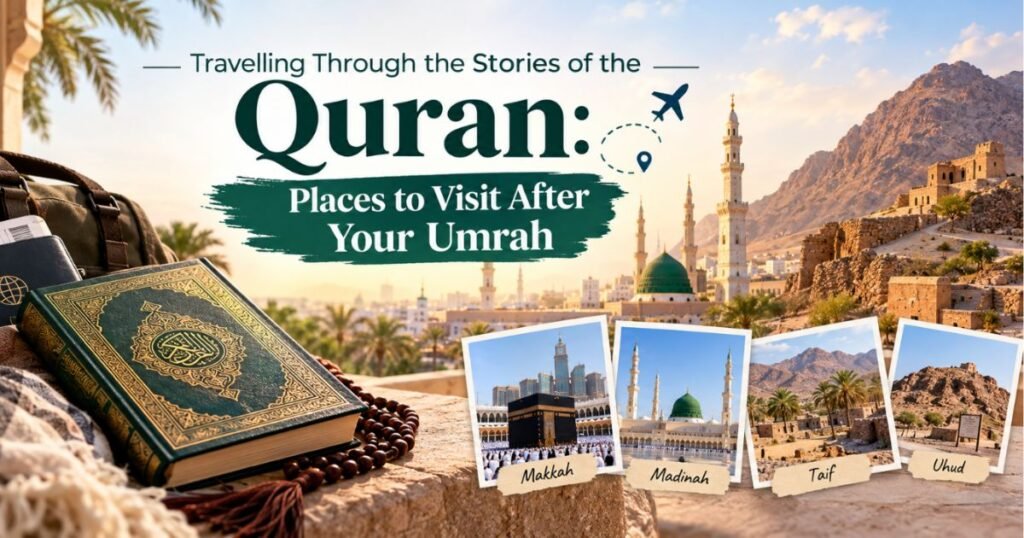



For most pilgrims flying out of the UK, whether they plan everything themselves or book one of the many all-inclusive Umrah packages from the UK, the trip revolves around two places: the Masjid al-Haram in Makkah and the Prophet’s Mosque in Madinah. That is exactly as it should be. But step a few kilometres beyond the Haram and you’ll find mountains, caves, mosques and museums that bring the Seerah to life in a way no book can.
These places are also easier to visit than ever. The Royal Commission for Makkah City and Holy Sites has restored 28 historical sites and opened 27 of them to visitors, with new visitor centres along the way. Visits to Makkah’s historical and cultural sites reached 5.9 million in the second quarter of 2026 alone, up 47% on the same period a year earlier.
In this guide, we’ve picked ten historical sites across Makkah, Madinah and Jeddah, with practical tips on timings, getting there and what to expect.
Please note: Makkah, and the Haram area of Madinah, are open to Muslims only. Opening times can change during Ramadan and Hajj season, so always check before you go.
Part 1: Historical sites in Makkah
1. Jabal Al Nour and Cave Hira
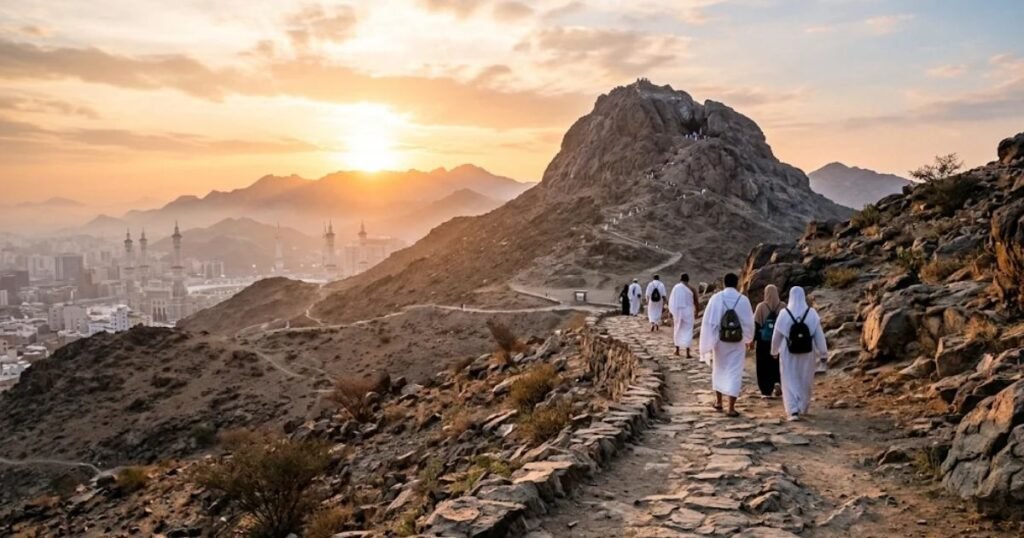
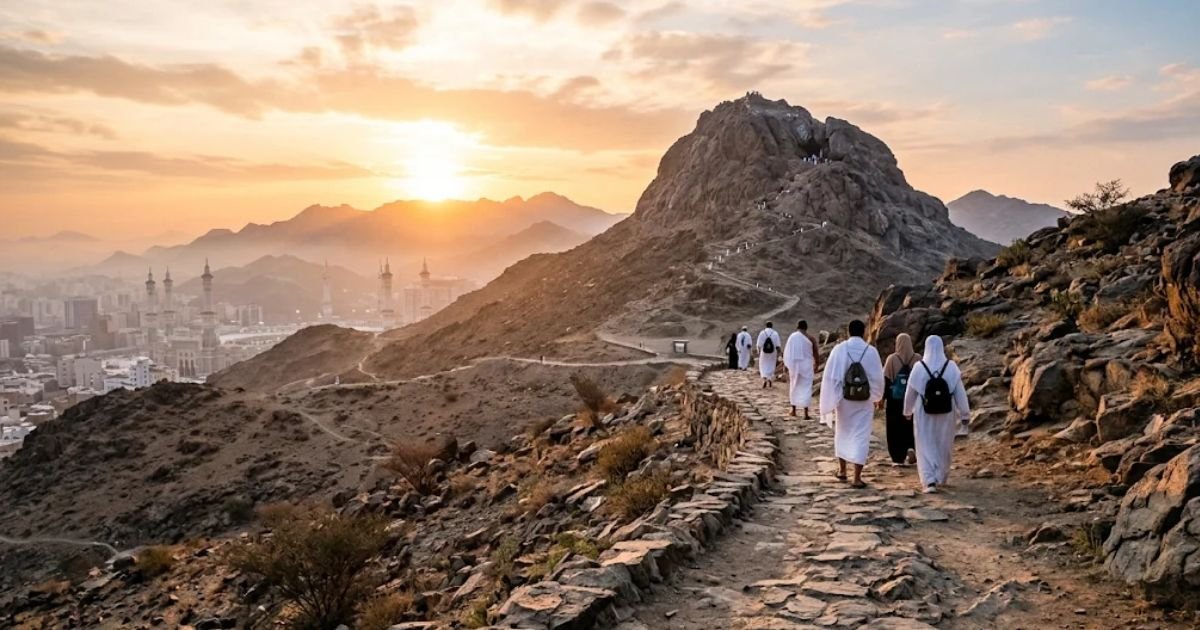
Jabal Al Nour, the “Mountain of Light”, rises about 4km north-east of the Grand Mosque. Near its summit is Cave Hira, where the Prophet Muhammad ﷺ used to retreat for reflection and where he received the first revelation of the Quran.
The climb is steep and can take up to two hours, depending on your fitness, the heat and the crowds. The cave itself is tiny, so expect to queue at busy times. Set off straight after Fajr, wear proper trainers rather than sandals, and carry plenty of water.
2. Hira Cultural District and the Revelation Exhibition
At the foot of Jabal Al Nour sits the Hira Cultural District, a modern 67,000 square-metre complex that has welcomed more than 4 million visitors from 132 nationalities. It’s an ideal stop before or after the climb, especially for families or anyone who can’t manage the mountain.
The centrepiece is the Revelation Exhibition, an interactive journey through the stories of the prophets, ending with the revelation to Prophet Muhammad ﷺ. Tickets cost around 30 SAR. The district also has the Saudi Coffee Museum, a cultural library and Hira Park. Allow three to four hours to see it properly. Visit Saudi has up-to-date details on the Hira Cultural District.
3. The Holy Quran Museum
Opened in March 2025 inside the Hira Cultural District, the Holy Quran Museum is the first museum in Makkah dedicated to the Quran. It traces how the Quran was revealed, written down and preserved over 14 centuries.
Highlights include rare manuscripts, historic copies of the Mushaf, ancient stone inscriptions of Quranic verses, and a photographed copy of the manuscript attributed to Caliph Uthman ibn Affan (RA). Since June 2026, the museum and the Revelation Exhibition have opened 24 hours a day, except on Fridays between 7am and 3:30pm.
Also worth a visit: right beside the Haram, in the Clock Tower complex, the International Museum of the Prophet’s Biography has more than 200 interactive exhibits in six languages, covering the Prophet’s life from his birth to the Hijrah.
4. Jabal Thawr and Cave Thawr
About 5km south of the Grand Mosque stands Jabal Thawr. When the Prophet ﷺ and Abu Bakr (RA) left Makkah for Madinah, they hid in a cave near its summit for three nights while the Quraysh searched for them. The Quran refers to this moment in Surah At-Tawbah (9:40).
The climb takes around 90 minutes to two hours and is tougher than Jabal Al Nour, so it suits fitter visitors. Go early in the morning, and don’t attempt it in the midday heat.
5. Jannat al-Mu’alla Cemetery
Jannat al-Mu’alla, in the Al Hajun area about 1km north of the Grand Mosque, is one of Makkah’s oldest burial grounds. It is the resting place of Khadijah (RA), the Prophet’s first wife, and is also associated with his grandfather Abdul Muttalib and his uncle Abu Talib.
Today the cemetery is deliberately plain, in keeping with the Islamic tradition of simple graves. Visitors usually stand at the boundary to make silent du’a. Access can be limited, especially during Hajj, so check locally before you go.
6. Masjid Al Bay’ah
Tucked into a mountain pass at the edge of Mina, Masjid Al Bay’ah marks the spot where the Ansar of Madinah pledged their support to the Prophet ﷺ. These were the Pledges of Aqabah, which opened the way for the Hijrah. The Abbasid Caliph Abu Ja’far al-Mansur built the mosque in 144 AH (761 CE).
Remarkably, the mosque stayed hidden behind Al-Aqabah Mountain until 2007, when expansion works in Mina removed the hill and revealed it. It’s about 7km from the Grand Mosque. Plan your visit outside the Hajj days, when movement around Mina is tightly controlled.
Part 2: Historical sites in Madinah
7. Masjid Quba and Masjid al-Qiblatayn
Masjid Quba, about 3.5km south of the Prophet’s Mosque, was the first mosque built in Islam. The Prophet ﷺ laid its foundations on arriving from Makkah, and praying two rak’ahs here is one of the most widely practised Sunnah acts in Madinah. The atmosphere is calmer than at the Haram, which makes it a lovely place for quiet reflection.
Around 4km north-west is Masjid al-Qiblatayn, the “Mosque of the Two Qiblas”. This is where the command came to change the direction of prayer from Al-Quds (Jerusalem) to the Ka’bah in Makkah.
The easiest way to reach both is the Madinah Hop-On Hop-Off bus, which leaves from near Gate 333 of the Prophet’s Mosque. A taxi or an organised ziyarat tour works just as well.
8. Mount Uhud, the Martyrs’ Cemetery and the “In His Footsteps” Hijrah route
Mount Uhud lies about 4.5km north of the Prophet’s Mosque. It was the site of the Battle of Uhud, where 70 companions were martyred, including the Prophet’s uncle Hamza ibn Abdul Muttalib (RA). They are buried in the Martyrs’ Cemetery at the foot of the mountain. Many visitors also climb the small Archers’ Hill (Jabal Rumah) opposite, from where you can see the whole battlefield.
New for 2026: Saudi Arabia has launched Ala Khutah (“In His Footsteps”), an experience that retraces the Prophet’s Hijrah from Makkah to Madinah. The 470km route runs from Cave Thawr to Quba Mosque. It passes 41 historic landmarks and has seven stations, one for each place the Prophet ﷺ is said to have stopped overnight. If you have extra days in Saudi Arabia, it’s an unforgettable way to connect your two cities.
9. Madinah’s museums
The International Fair and Museum of the Prophet’s Biography, just south of the Prophet’s Mosque, is the best place to start. Its “Lights and Landmarks” pavilion has more than 20 sections showing the Madinah of the Prophet’s time, with content in more than seven languages. It’s especially good for children.
For something more traditional, the Dar Al-Madinah Museum has more than 2,000 artefacts and detailed models of the city’s history. You may have read about the Hejaz Railway Museum in the Ottoman-era station. At the time of writing, it is temporarily closed for refurbishment, though you can still see the station’s exterior.
Visiting Rawdah? Entry to Al-Rawdah Al-Sharifah inside the Prophet’s Mosque needs a free, timed permit from the official Nusuk app. You’ll usually get about 10 minutes inside. Children aged five and over need their own permit, and slots go quickly, so book as early as you can.
Part 3: Jeddah
10. Historic Jeddah (Al-Balad), “the Gate to Makkah”
Most UK flights for Umrah land in Jeddah, and many pilgrims rush straight on to Makkah. It’s worth slowing down. For centuries, pilgrims arriving by sea came ashore here before travelling inland, which is why UNESCO lists the old town as “Historic Jeddah, the Gate to Makkah”. It became a World Heritage Site in 2014.
Wander the lanes of Al-Balad to see tall coral-stone houses with carved wooden roshan balconies, and souqs such as Souq Al-Alawi. Don’t miss Naseef House, a beautifully restored merchant’s home that later served as a residence for King Abdulaziz.
Also in Jeddah, the Al-Makkatain Museum holds rare drawings, engravings and early photographs of Makkah and Madinah, including a 16th-century drawing of Makkah. It’s a fascinating way to see how the holy cities have changed over the centuries.
Tip: Al-Balad is best explored in the late afternoon and evening, when it’s cooler. It also works well on the day you arrive or the day you leave.
How to fit ziyarat into your Umrah trip
You don’t need extra holiday to see these places. With a little planning, most of them fit around your prayers and rituals.
- Allow one free morning in each city. In Makkah, climb Jabal Al Nour after Fajr, then spend the late morning in the Hira Cultural District. In Madinah, a half-day circuit of Quba, Qiblatayn, the Seven Mosques and Uhud gets you back in time for Dhuhr.
- Beat the heat. Visit outdoor sites early in the morning or after Asr. From May to September, temperatures regularly pass 40°C.
- Dress for comfort. You don’t need ihram for ziyarat. Modest, loose clothing and good walking shoes are best, especially for the mountain climbs.
- Getting around. Taxis, Careem and Uber are easy to use in both cities. In Madinah, the Hop-On Hop-Off bus covers most of the main sites.
- Sort your permits early. Your Umrah slot and Rawdah visit are both booked through the Nusuk app, so set it up before you leave the UK.
If you’d rather have everything arranged for you, many UK pilgrims book through agencies that build ziyarat into the trip. Safa Travel, a London-based, ATOL-protected Umrah specialist, offers packages that include flights, hotels, visa support and guided ziyarat in both Makkah and Madinah. That way you can focus on your worship while someone else handles the logistics.
Final thoughts
Umrah is, first and foremost, an act of worship. But standing where the Quran was first revealed, where the Hijrah began, and where the first mosque in Islam was built adds a depth to the journey that stays with you long after you return home. With new museums opening and historic sites being restored every year, there has never been a better time to see the Makkah and Madinah of the Seerah.
If you can, give yourself two full days in each city. Save this guide for your trip, and share it with family and friends who are planning their own journey.
Frequently asked questions
Can non-Muslims visit these sites?
No for Makkah, which is open to Muslims only. The Haram area of Madinah is also restricted. Historic Jeddah (Al-Balad) is open to all visitors.
How long does it take to climb Jabal Al Nour to Cave Hira?
Up to two hours, depending on your fitness, the heat and the crowds. Start after Fajr for the coolest conditions.
Do I need tickets for the Holy Quran Museum?
The Revelation Exhibition in the Hira Cultural District is ticketed, at around 30 SAR. Check the latest prices and opening times on Visit Saudi or at the site before you go.
Do I need a permit to visit the Rawdah in Madinah?
Yes. It’s free and booked through the official Nusuk app. Slots are released in advance and fill quickly.
What is the best time of year to visit?
The cooler months, November to March, are the most comfortable for climbing and sightseeing. Expect bigger crowds during Ramadan and the school holidays.