





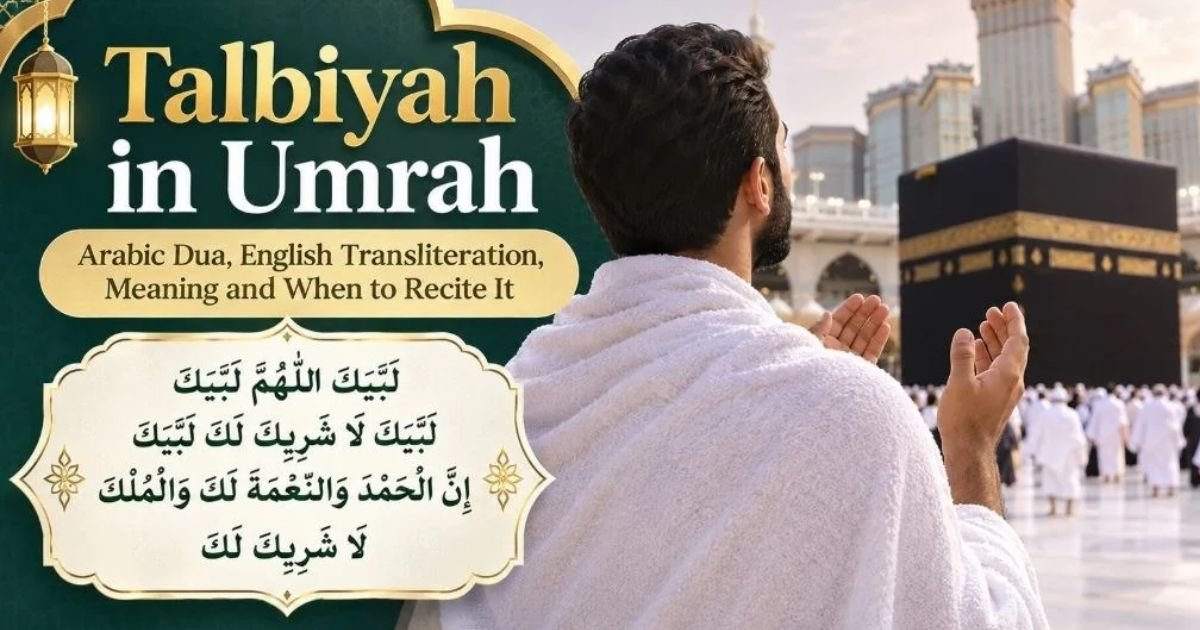
The Talbiyah is one of the most important recitations associated with Umrah. Pilgrims begin reciting it when entering the state of Ihram and continue repeating it during their journey to Makkah. Its words express a Muslim’s response to Allah’s call, affirming His oneness, praise, blessings and sovereignty.
If you are preparing for Umrah, learning the Talbiyah in Arabic, understanding its English meaning and knowing when to recite it can help you perform this part of the pilgrimage with greater understanding.
What Is Talbiyah in Umrah?
Talbiyah is a prescribed remembrance recited by Muslims performing Hajj or Umrah after entering Ihram. Its opening words, Labbayka Allahumma labbayk, mean, “Here I am, O Allah, here I am.“
The Talbiyah expresses a pilgrim’s response to Allah’s invitation to perform the pilgrimage. It also declares that Allah has no partner and that all praise, blessings and sovereignty belong to Him.
The wording of the Prophet Muhammad’s ﷺ Talbiyah is reported in authentic narrations, including Sahih al-Bukhari and Sahih Muslim.
Talbiyah Dua in Arabic
The following is the well-known wording of the Talbiyah recited by the Prophet Muhammad ﷺ:
لَبَّيْكَ اللَّهُمَّ لَبَّيْكَ
لَبَّيْكَ لَا شَرِيكَ لَكَ لَبَّيْكَ
إِنَّ الْحَمْدَ وَالنِّعْمَةَ لَكَ وَالْمُلْكَ
لَا شَرِيكَ لَكَ
It is reported in Sahih al-Bukhari (1549) and Sahih Muslim (1184). Hadith numbering can vary between editions.
Talbiyah in English: Transliteration
If you cannot read Arabic script fluently, the English transliteration can help you learn the words and practise their pronunciation.
Labbayka Allahumma labbayk.
Labbayka la shareeka laka labbayk.
Innal-hamda wan-ni’mata laka wal-mulk.
La shareeka lak.
Read each line slowly and practise the complete recitation until you become familiar with it. Transliteration is a learning aid; it cannot represent every Arabic sound perfectly. Whenever possible, listen to a reliable Arabic recitation and learn the correct pronunciation.
Talbiyah Meaning in English
The English translation of the Talbiyah is:
Here I am, O Allah, here I am. Here I am; You have no partner; here I am. Indeed, all praise, blessings and sovereignty belong to You. You have no partner.
Understanding the meaning helps pilgrims recognise what they are declaring when they recite these words.
Meaning of Each Part of the Talbiyah
| Arabic phrase | English transliteration | Meaning |
| لَبَّيْكَ اللَّهُمَّ لَبَّيْكَ | Labbayka Allahumma labbayk | Here I am, O Allah, here I am. |
| لَبَّيْكَ لَا شَرِيكَ لَكَ لَبَّيْكَ | Labbayka la shareeka laka labbayk | Here I am; You have no partner; here I am. |
| إِنَّ الْحَمْدَ | Innal-hamda | Indeed, all praise belongs to You. |
| وَالنِّعْمَةَ | Wan-ni’mata | And all blessings belong to You. |
| لَكَ وَالْمُلْكَ | Laka wal-mulk | To You belong sovereignty and dominion. |
| لَا شَرِيكَ لَكَ | La shareeka lak | You have no partner. |
The Talbiyah therefore contains a clear declaration of Tawheed (the oneness of Allah). It acknowledges that Allah alone deserves worship and that all praise, blessings and dominion belong to Him.
How to Pronounce Talbiyah
For beginners, learning the Talbiyah one phrase at a time can make memorisation easier.
- Labbayka Allahumma labbayk: Begin with Lab-bay-ka, followed by Al-lah-hum-ma lab-bayk.
- Labbayka la shareeka laka labbayk: Pay attention to the pronunciation of shareeka and laka.
- Innal-hamda wan-ni’mata laka wal-mulk: Practise this line slowly, especially the sounds in ni’mata and mulk.
- La shareeka lak: Repeat the final phrase clearly.
These spellings are approximate pronunciation guides, not a substitute for learning the Arabic sounds. Listening to a qualified Quran or Arabic teacher can help you pronounce the words more accurately.
When to Start Reciting Talbiyah for Umrah
A pilgrim begins reciting the Talbiyah in connection with entering Ihram for Umrah. The practical steps are:
- Prepare before the Miqat: Wear the appropriate Ihram clothing before reaching the Miqat. Men generally wear two unstitched pieces of cloth, while women wear modest clothing that meets the requirements of Islamic dress.
- Make the intention: At the Miqat, make the intention to perform Umrah and enter the state of Ihram.
- Recite the Talbiyah: Begin reciting the Talbiyah as part of entering Ihram.
- Continue during the journey: Repeat the Talbiyah frequently while travelling towards Makkah.
Remember that wearing Ihram clothing alone does not necessarily mean you have entered the state of Ihram. The intention and the relevant rites are important. Pilgrims should also follow the guidance of their chosen school of Islamic jurisprudence for the precise details of entering Ihram.
After entering Ihram, pilgrims continue their journey towards Makkah while remembering Allah. Those arranging their journey in advance can also plan their Umrah transport from the Miqat to their accommodation in Makkah.
When to Stop Reciting Talbiyah in Umrah
One of the common questions among Umrah pilgrims is when they should stop reciting the Talbiyah.
The commonly taught practice is to stop reciting it when beginning Tawaf around the Kaaba. The pilgrim then performs Tawaf and continues with Sa’i between Safa and Marwah.
However, scholars have differed over the precise stopping point. Some scholarly opinions allow Talbiyah to continue beyond the beginning of Tawaf, while other commonly followed guidance instructs pilgrims to stop at that point.
For this reason, pilgrims should follow reliable guidance from a qualified scholar or the Islamic school they follow rather than assume that every school has exactly the same ruling.
How Often Should You Recite Talbiyah?
There is no fixed total number of times that a pilgrim must recite the Talbiyah during Umrah. It is recommended to repeat it frequently while in Ihram.
You can recite it while:
- Walking or sitting.
- Travelling towards Makkah.
- Riding in a car or other transport.
- Waiting during your journey.
- Moving between different places before reaching the point at which you stop Talbiyah.
Some guides recommend repeating the Talbiyah three times on an occasion. However, this should not be confused with a compulsory count or a requirement to recite it exactly three times throughout Umrah.
The important practice is to remember Allah and repeat the Talbiyah frequently during Ihram.
Talbiyah for Men and Women
Men and women both recite the Talbiyah when performing Umrah, but the guidance about the volume of recitation differs.
For men: Men are encouraged to raise their voices when reciting the Talbiyah, making it audible.
For women: Women generally recite the Talbiyah quietly, particularly where unrelated men may hear them. The precise guidance on how audible a woman’s recitation should be can differ among scholars.
Both men and women should learn the wording and recite it with attention to its meaning.
Can You Recite Talbiyah Without Wudu?
Yes. Wudu is not a condition for reciting the Talbiyah. It is a form of remembrance of Allah, so a pilgrim may recite it while walking, sitting or travelling without having performed ablution.
A woman may also recite the Talbiyah during menstruation while in Ihram. Menstruation does not prevent her from making this remembrance, although it affects certain other acts of worship, including performing Tawaf until she becomes pure.
Frequently Asked Questions
1. Can I recite Talbiyah in English?
It is best to learn and recite the established Arabic wording of the Talbiyah. The English transliteration can help you pronounce the Arabic words, while the English translation helps you understand their meaning. Whether a translation can substitute for the Arabic wording when someone is unable to recite it is a matter of Islamic jurisprudence, so ask a qualified scholar for guidance according to the school you follow.
2. Can I listen to Talbiyah and repeat after it?
Yes. Listening to a reliable Arabic recitation and repeating the words can help you learn the correct pronunciation and memorise the Talbiyah. Practise each line separately before reciting the complete wording.
3. Can I recite Talbiyah while travelling?
Yes. Pilgrims can recite the Talbiyah while walking, sitting or travelling in a vehicle. It is not restricted to a particular posture or mode of transport.
4. Is there a specific dua to recite after Talbiyah?
The established Talbiyah itself is the main recitation. A pilgrim may also make personal supplications and remember Allah. However, additional supplications should not be presented as obligatory or as a prescribed Sunnah without reliable evidence.
5. Is Talbiyah recited during Tawaf?
The commonly taught practice is to stop Talbiyah when beginning Tawaf for Umrah. Scholars differ on this point, so pilgrims should follow the reliable guidance of their chosen school or scholar.
6. What if I forget to recite Talbiyah?
The legal consequences depend on the circumstances and the school of Islamic jurisprudence being followed. Scholars differ on the legal status of Talbiyah and its role in entering Ihram. If you have forgotten it or are unsure whether you entered Ihram correctly, ask a qualified scholar rather than assume that your Umrah is invalid.
Conclusion
Talbiyah is an important part of the Umrah journey. Its Arabic words declare a pilgrim’s response to Allah, affirm His oneness and acknowledge that all praise, blessings and sovereignty belong to Him.
Before travelling for Umrah, learn the Arabic wording, practise its pronunciation and understand its English meaning. Knowing when to begin and stop reciting it will also help you follow the rites of Umrah with greater confidence and awareness.